How Amazon Product Videos Reduce Returns and Increase CVR
How Amazon Product Videos Reduce Returns and Increase CVR
High-quality Amazon product videos are the key to solving a problem most sellers don't talk about publicly: high return rates.
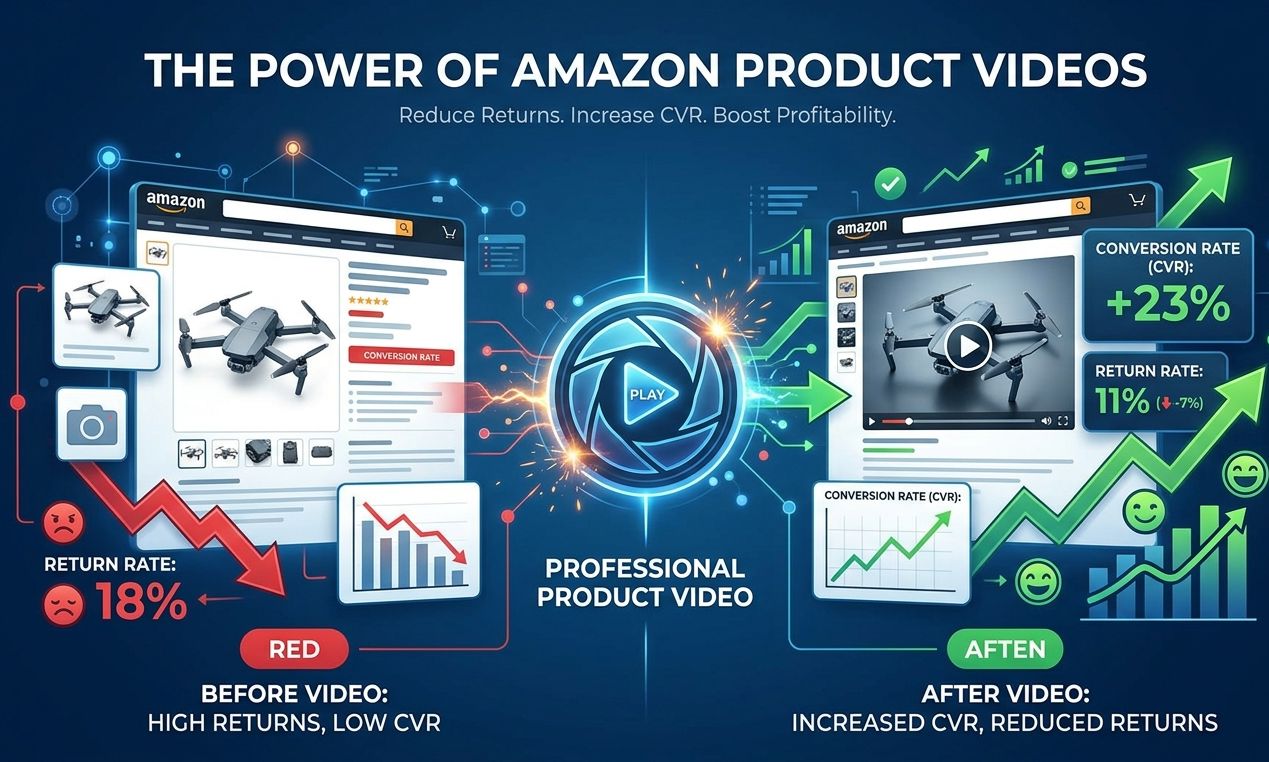
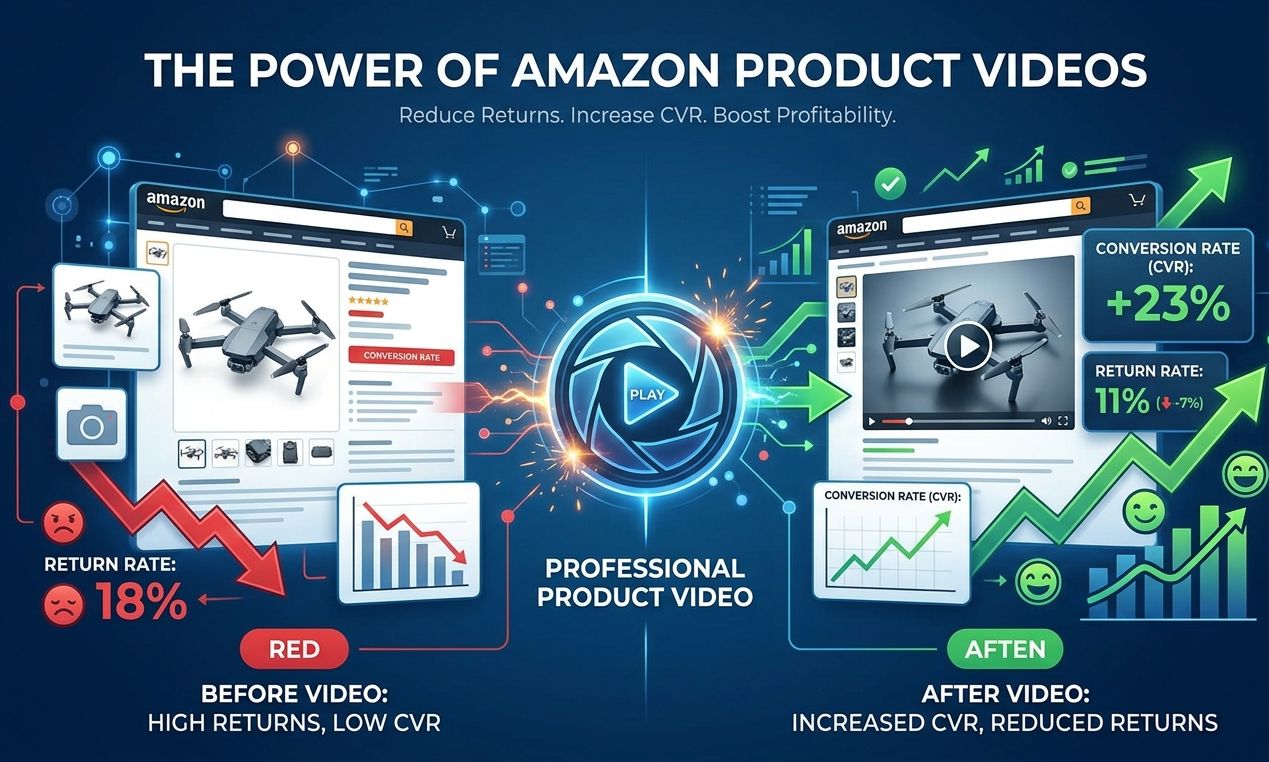
A brand selling $1.5 million per year on Amazon contacted us with a problem most sellers don't talk about publicly: their return rate was sitting at 18%. Their product wasn't defective. Their reviews were solid. But buyers kept receiving items that didn't match what they expected.
The culprit wasn't the product. It was the listing.
Their main images were clean. Their bullet points were detailed. But they had no video — and no video meant buyers were filling in the gaps with their imagination. Imagination, as it turns out, is rarely accurate.
Within 60 days of adding a professionally produced product video to their main listing, their return rate dropped to 11%. Their conversion rate (CVR) increased by 23%. Same product, price and reviews. Different result.
This article breaks down exactly why that happens, what the data says about video and CVR on Amazon, and what separates a video that converts from one that gets ignored.
Why Amazon Product Videos are Essential for Listing Success
──────────────────────────────────────────────────
Amazon is a high-trust, low-patience environment. A buyer has seconds to decide whether your product is worth their attention. In that window, static images and text have to do an enormous amount of work — and they consistently fall short in two specific areas:
Communicating scale and context. A product photo on a white background tells a buyer almost nothing about how big, heavy, or tactile a product actually is. Video shows it in someone's hand, next to a familiar object, in a real environment. That context eliminates one of the most common reasons for returns: "it was smaller than I expected."
Demonstrating function. For any product that moves, assembles, unfolds, or performs a task, static images force buyers to imagine how it works. Video removes that uncertainty entirely.
When buyers don't fully understand what they're buying, one of two things happens: they don't buy at all (conversion loss), or they buy and return it when reality doesn't match expectation (return loss). Both are expensive. Video attacks both problems simultaneously.
What the Data Says About Amazon Product Videos and CVR
──────────────────────────────────────────────────
Amazon doesn't publish platform-wide CVR data by listing type, but the evidence from sellers and agencies consistently points in the same direction.
Amazon's own internal data, shared through their Seller Central resources, indicates that listings with video see an average CVR improvement in the range of 9–11% across categories. In competitive categories — electronics, kitchen, fitness, beauty — that number climbs higher because the baseline competition from other listings makes any differentiation more valuable.
From the listings we've optimized at MyBrand Videos, we consistently see:
• Listings adding their first video: CVR improvement between 15–30%, depending on category and how underperforming the listing was before.
• Listings replacing a low-quality DIY video with professional production: CVR improvement between 8–18%.
• Listings adding A/B-tested video variants: An additional 5–12% improvement over the original video, once the winning variant is identified.
The compounding effect matters here. A seller doing $2M/year with a baseline CVR of 12% who improves to 15% doesn't just get 3% more conversions — they get roughly $500,000 in incremental annual revenue from the same traffic. That math is why high-volume sellers treat Amazon product videos as infrastructure, not marketing.
How Amazon Product Videos Directly Reduce Return Rates
──────────────────────────────────────────────────
The connection between video and return reduction is more direct than most sellers realize.
Returns happen for three primary reasons:
• Expectation mismatch — the product looks or functions differently than anticipated
• Setup or usage confusion — the buyer couldn't figure out how to use it correctly
• Undisclosed limitations — a dimension, material, or compatibility wasn't clear from the listing
A well-produced product video addresses all three.
For expectation mismatch, lifestyle footage showing the product in real use — held by a human hand, placed on an actual surface, photographed in context — closes the gap between what a buyer imagines and what they'll receive. This is especially critical for products where scale, weight, or finish are purchase drivers.
For usage confusion, a brief demonstration segment (30–45 seconds of the product being assembled, operated, or applied) reduces post-purchase frustration and the "this is too complicated" return. We've seen this single addition reduce returns for fitness and electronics categories by 4–7 percentage points.
For undisclosed limitations, a well-scripted video can proactively address the questions buyers ask before returning. If a common negative review says "the strap isn't long enough for larger wrists," your video should show the strap at maximum extension, with a measurement on screen. This doesn't just reduce returns — it also pre-qualifies buyers, so the ones who convert are more likely to be satisfied.
The Anatomy of Amazon Product Videos That Actually Convert
──────────────────────────────────────────────────
Not all video is equal on Amazon. A three-minute product tour shot on a smartphone performs differently than a structured, 60-second video built around the purchase decision. Here's what the best-performing Amazon product videos have in common:
▸ 1. A hook in the first 3 seconds
Amazon autoplay begins with the sound off. Your first frame needs to communicate value without audio — a clean product shot, a bold text overlay with the core benefit, or a before/after visual that creates immediate curiosity. If your video opens with a logo or a slow pan, you've already lost most viewers.
▸ 2. A clear problem-solution structure
The highest-converting videos follow a simple arc: identify a specific pain point the buyer has, show the product solving it, then deliver the proof (a result, a demonstration, a testimonial). This structure mirrors the buyer's decision process and makes the case for purchase without the viewer having to connect the dots themselves.
▸ 3. Social proof woven in
A customer testimonial clip — even 10–15 seconds of a real buyer describing their experience — meaningfully improves conversion when placed in the second half of the video. Amazon buyers trust other Amazon buyers. A face saying "I was skeptical but this actually works" does more conversion work than any product claim you can write.
▸ 4. Length between 45 and 90 seconds
Shorter than 45 seconds rarely leaves enough time to build trust. Longer than 90 seconds sees significant drop-off for most product categories. The exception: complex products (industrial equipment, professional tools, technical software peripherals) where buyers expect and want more information.
▸ 5. Closed captions
The majority of Amazon video views happen with the sound off. Closed captions aren't just an accessibility feature — they're a conversion tool. Listings with captioned video consistently outperform uncaptioned video, particularly on mobile.
A/B Testing Your Amazon Product Videos to Maximize Revenue
──────────────────────────────────────────────────
Most sellers upload one video and leave it running indefinitely. This is the equivalent of writing one version of a headline and never testing another — it's leaving optimization potential untouched.
Amazon's Manage Your Experiments tool allows Brand-registered sellers to A/B test listing content, including A+ Content modules. While direct video A/B testing within Amazon's native tools has limitations, sophisticated sellers use a combination of Manage Your Experiments for surrounding listing elements and third-party analytics to measure video performance variants over time.
The variables worth testing:
Video thumbnail. The still frame that appears before a viewer presses play has a dramatic impact on view rate. A thumbnail showing a product in use, with a human face, typically outperforms a plain product shot. We've seen thumbnail changes alone improve play rates by 20–35%.
Opening 5 seconds. Testing a benefit-led opening ("Finally, a [product category] that actually [key benefit]") against a problem-led opening ("If you're tired of [pain point]...") consistently produces meaningful differences. The winner varies by category and audience.
Video length. Testing a 60-second version against a 90-second version of the same content tells you whether your audience wants more or less information. For most commodity products, shorter wins. For considered purchases, longer tends to convert better.
CTA placement and language. Where and how you tell buyers to act — whether with on-screen text, a voiceover prompt, or a closing title card — affects follow-through. Testing "Order today" against "See all sizes and options" can reveal surprising differences in buyer behavior.
What Separates Professional Video from DIY on Amazon
──────────────────────────────────────────────────
There's a visible quality threshold on Amazon that matters more as the price point of your product increases. For a $12 product, a clean smartphone video may be sufficient. For a $150+ product — which is the territory most high-volume private label brands occupy — production quality signals product quality directly.
Buyers at higher price points are making a higher-trust decision. A poorly lit, shaky, low-resolution video communicates that the brand doesn't take its product seriously. That's a conversion killer.
Professional production brings three things that DIY consistently lacks:
Color accuracy. Professional cameras and grading ensure the product on screen matches the product in the box. Color discrepancy is a silent return driver — buyers receive items that look different than what they saw, even when the product itself is correct.
Audio quality. For videos with voiceover or on-screen demonstrations, professional audio removes distractions. Buyers notice background noise and echo even when they can't articulate why a video feels "off."
Structured scripting. Professional production starts with a script built around conversion goals, not around what the producer thinks looks cool. Every second of a well-produced Amazon video is doing a specific job in the purchase funnel.
The ROI Calculation for Amazon Sellers Considering Professional Video
──────────────────────────────────────────────────
Here's a straightforward framework for evaluating your investment in Amazon product videos.
Take your current monthly units sold × current CVR × average selling price. Then apply a conservative 15% CVR improvement (below our average observed result). The difference in monthly revenue is your baseline return on video.
Example: A seller moving 800 units/month at a 10% CVR and $89 ASP generates $71,200/month. A 15% CVR improvement to 11.5% brings that to $81,880/month — an increase of $10,680 per month, or $128,160 annually. A professional video investment in the $3,000–$8,000 range pays for itself in the first month.
Add the return rate calculation on top of that — reducing returns from 15% to 10% on 800 units at $89 saves approximately $3,560/month in refunds and reverse logistics — and the combined ROI case becomes difficult to argue against.
The Bottom Line
──────────────────────────────────────────────────
Amazon product video isn't a nice-to-have for high-volume sellers. It's the highest-leverage listing optimization available, with measurable impact on both sides of the profitability equation: more conversions in, fewer returns out.
The sellers we work with who treat video as a core operational investment — not a one-time marketing expense — consistently see compounding improvements as they test, optimize, and update their creative over time.
If you're selling above $500K/year on Amazon and don't have professional video on your top ASINs, you're leaving a measurable amount of revenue on the table every month.
Ready to See What Professional Video Does for Your Listings?
──────────────────────────────────────────────────
At My Brand Videos, we specialize in Amazon product video production and CVR optimization for 6–8 figure sellers. We don't just produce video — we build creative assets designed around your specific conversion goals, with A/B testing strategy built in from the start.
Schedule a free listing audit →
We'll review your top three ASINs and show you exactly where video can move the needle on your CVR and return rate.
