Amazon Video Production Timeline: What Sellers Should Expect
Amazon video production timeline is one of the most frequently misunderstood aspects of video investment for Amazon sellers — and the source of some of the most avoidable launch delays and rushed production decisions in the platform's seller community. Sellers who don't understand the realistic timeline for professional video production either plan launches without accounting for production time, or make rushed production decisions to meet arbitrary deadlines that result in weaker creative and lower returns.
This guide covers what a realistic Amazon video production timeline looks like at each stage, what affects the timeline most significantly, and how to build production timing into launch and content strategy planning.
The Standard Amazon Video Production Timeline
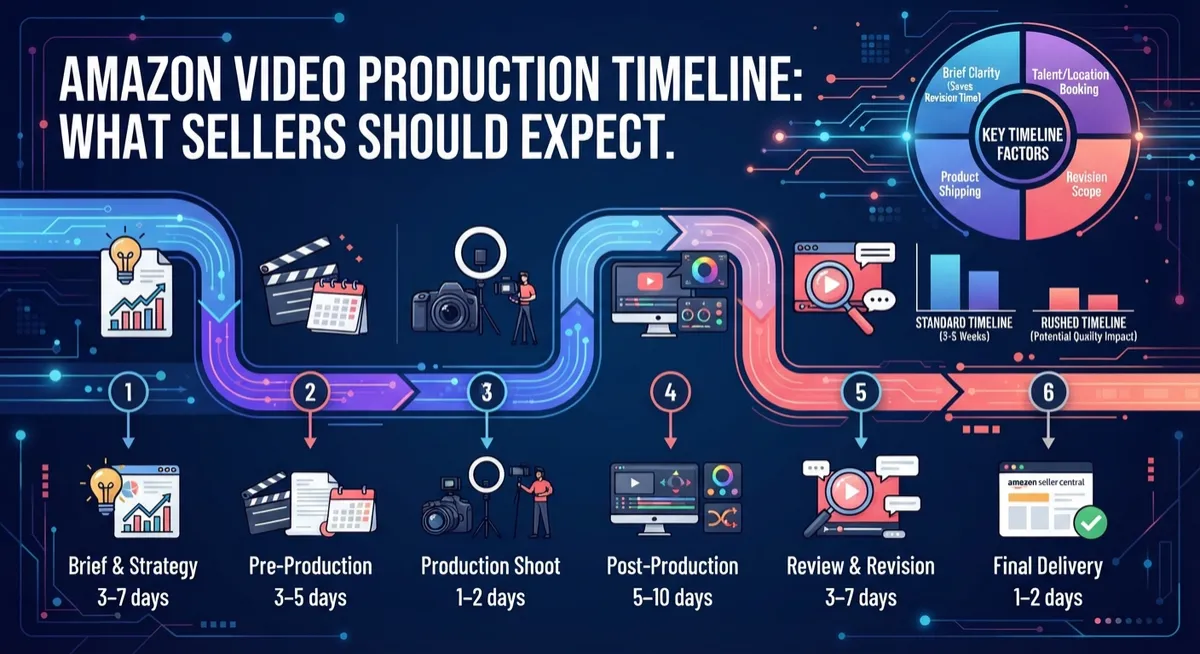
A standard professional Amazon listing video production — from initial engagement to final delivery — typically takes 3 to 5 weeks when all parties are responsive and the brief is clearly defined at the start. This is a realistic baseline that accounts for the necessary stages without assuming either maximum efficiency or unnecessary delays.
Stage one: Brief development and creative strategy (3–7 days). Before production begins, a competent agency invests time in understanding the product, the category, the buyer, and the specific conversion objectives the video needs to serve. This stage includes review of category competitive video, analysis of your listing's return reasons and buyer objections, and development of the creative brief that will guide all subsequent production decisions. Rushing this stage — either by starting with a vague brief or skipping competitive analysis — is the primary cause of videos that look finished but underperform on conversion.
Stage two: Pre-production planning (3–5 days). Pre-production covers location scouting (if relevant), talent casting and booking, prop sourcing, script development, shot list creation, and logistics coordination. For location shoots with models, this stage takes longer — 5 to 7 days — due to talent booking lead times and location confirmation requirements. For studio-only productions, this stage can be compressed to 2 to 3 days.
Stage three: Production shoot (1–2 days). The actual shoot day(s) typically represent the shortest clock-time in the process but require the most intensive real-time management. A single well-organized studio production day generates sufficient material for one to two videos. Location productions with models and multiple environments typically require two days: one setup day and one shoot day.
Stage four: Post-production editing (5–10 days). Video editing, color grading, motion graphics, text overlay design, music selection, caption addition, and format optimization typically take 5 to 10 business days depending on the number of deliverables and the complexity of the edit. For packages including multiple videos (listing video + PPC ad + variant), this stage extends to 8 to 12 business days.
Stage five: Review and revision (3–7 days). Client review, revision requests, revision execution, and final approval typically add 3 to 7 days to the timeline — longer if stakeholder approval involves multiple parties or if significant revision requests require re-editing. One structured review cycle is standard; additional rounds extend the timeline proportionally.
Stage six: Final delivery and format optimization (1–2 days). Final file delivery in Amazon-compliant formats, thumbnail extraction, and documentation of technical specifications typically takes 1 to 2 business days after final approval.
Factors That Extend or Compress the Timeline
Understanding what extends the typical timeline helps sellers plan around these factors.
Talent and location availability. For productions requiring professional models, specific location types, or specialized talent, booking lead times can extend pre-production by 1 to 2 weeks in peak booking periods. Planning productions during slower talent booking seasons (January, August, early fall) typically reduces this lead time.
Brief clarity at the start. Productions that begin with a fully defined brief — clear conversion objective, identified buyer persona, specific objections to address, defined visual direction — move through every subsequent stage faster than productions where these decisions are made iteratively. The 3 to 7 day brief development stage is time well invested: every day of clarity at the brief stage saves multiple days of revision at the editing stage.
Product shipping time. For sellers shipping products to a remote production studio, shipping transit time adds to the effective timeline — particularly for international sellers shipping to a US-based studio. Products should be shipped before the brief development stage concludes so they arrive ready for the shoot day.
Revision scope. Minor revision requests — timing adjustments, text overlay changes, music alternatives — can be completed within 24 to 48 hours. Significant revision requests — reordering major segments, recutting to address new objectives, adding new content not captured in the original shoot — may require schedule coordination for additional shooting days.
Planning Amazon Video Production Into Launch Strategy
The most costly timeline mistakes happen when video production is planned around a launch date rather than when the launch date is planned around video production completion.
For new product launches. Video should be completed and approved at least 2 weeks before the planned launch date — to allow for Amazon's listing video upload processing time, any technical compliance issues, and time to configure Sponsored Brand Video campaigns before launch. The most effective launch strategies plan video production to complete 3 to 4 weeks before launch.
For listing refreshes. For established listings where video is being updated or added for the first time, production can be timed for any period — but should account for the 60 to 90 day timeline for organic rank improvement to begin appearing after video launch. Sellers who want to see rank improvement before the holiday selling season, for example, should launch updated video no later than September.
For monthly subscription content cycles. Ongoing production relationships with predictable monthly delivery depend on a steady brief-to-delivery cycle. The brief for the following month's production should be finalized before the current month's production is delivered — maintaining the pipeline that prevents gaps in the monthly content cycle.
Rush Production: When It's Worth It and When It Isn't
Rush production — compressing the standard timeline to meet an earlier deadline — is occasionally necessary and usually involves tradeoffs worth understanding.
The stages that can be compressed without quality impact: pre-production (if the brief is already perfectly clear and talent is available) and post-production (with rush fees, most agencies can expedite editing turnaround).
The stages that cannot be meaningfully compressed without quality impact: brief development and strategic planning. A production begun without a clear brief on Monday will produce content that reflects that lack of clarity — and that clarity gap will show up in the final video's conversion performance, not just in the production process.
Ready to Plan Your Amazon Video Production?
At MyBrand Videos, we walk through production timeline at the first call — building it around your launch schedule and ensuring product shipping, shoot scheduling, and delivery timing are all coordinated before engagement begins.
Related articles:
