Competitor Video Analysis for Amazon Listings: How to Win
Competitor Video Analysis for Amazon Listings: How to Win
Amazon competitor video analysis is the step most sellers skip entirely — and it is often the reason they keep losing to brands that seem to have figured something out they haven't. The answer, however, is usually visible in plain sight, sitting inside a competitor's listing video. You just need to know what to look for.
This guide walks you through a systematic framework for running Amazon competitor video analysis — specifically, what to audit, what the findings tell you, and how to translate those insights into creative that outconverts what is already ranking in your category.
Why Amazon Competitor Video Analysis Is Non-Negotiable
Before you produce a single frame of video for your listing, you need to know what you are competing against. Not in a vague "see what's out there" way — but in a structured, documented way that gives you specific, actionable intelligence.
The reason this matters is straightforward: Amazon's search results for any competitive keyword are a natural experiment that has already been running for months or years. The brands ranking in the top positions have survived buyer scrutiny, algorithm updates, and competitive pressure. Consequently, their creative has been tested by millions of impressions. When you audit it, you are reading the results of an experiment you did not have to pay for.
Most sellers look at competitor listings and think "theirs looks more professional than mine." That is the wrong level of analysis, however. The right question is: what specific creative decision is driving their conversion — and what gap does it leave for you to exploit?
▸ Why Most Sellers Skip This Step
The most common reason sellers skip Amazon competitor video analysis is time. A proper audit of 5–8 competitor videos feels like a research project, and most Amazon operators are already stretched thin. That said, the 90 minutes this takes before a production saves multiples of that in misdirected creative spend afterward.
Step 1: Build Your Amazon Competitor Video Audit List
──────────────────────────────────────────────────
Start by identifying the 5–8 listings you are directly competing with for your highest-value keywords. These are, specifically, the ASINs appearing consistently in positions 1–5 for the search terms that drive the most revenue to your category.
For each competitor, you need three things before pressing play.
The video itself. Watch it fully, at least twice. First, watch for the overall impression. Then, on the second viewing, pause at each structural element with a notepad in hand.
The listing context. Note their main image, title, bullet points, and review count. The video does not exist in isolation — it is part of a listing ecosystem. Understanding how the video fits the rest of the listing, therefore, tells you about their overall creative strategy.
Their review data. Focus specifically on negative reviews. One-star and two-star reviews are the clearest signal of buyer expectations that were not met. If multiple reviewers mention the same issue and the competitor's video does not address it, that is your opening.
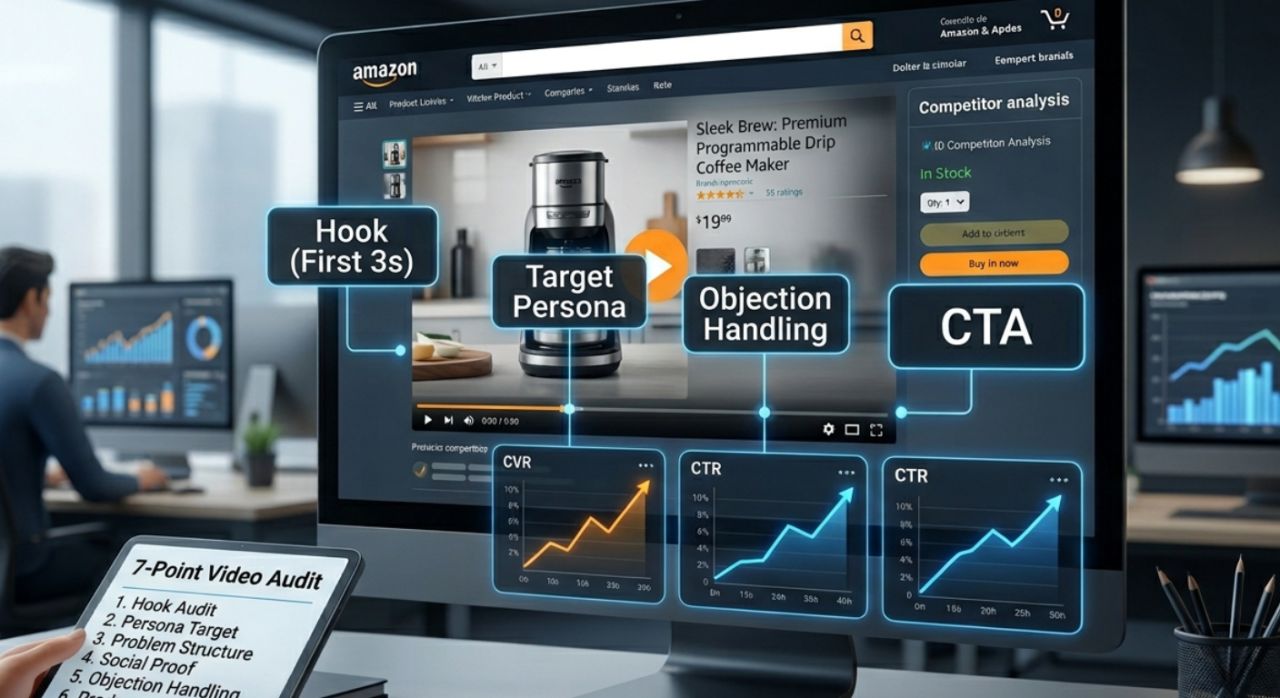
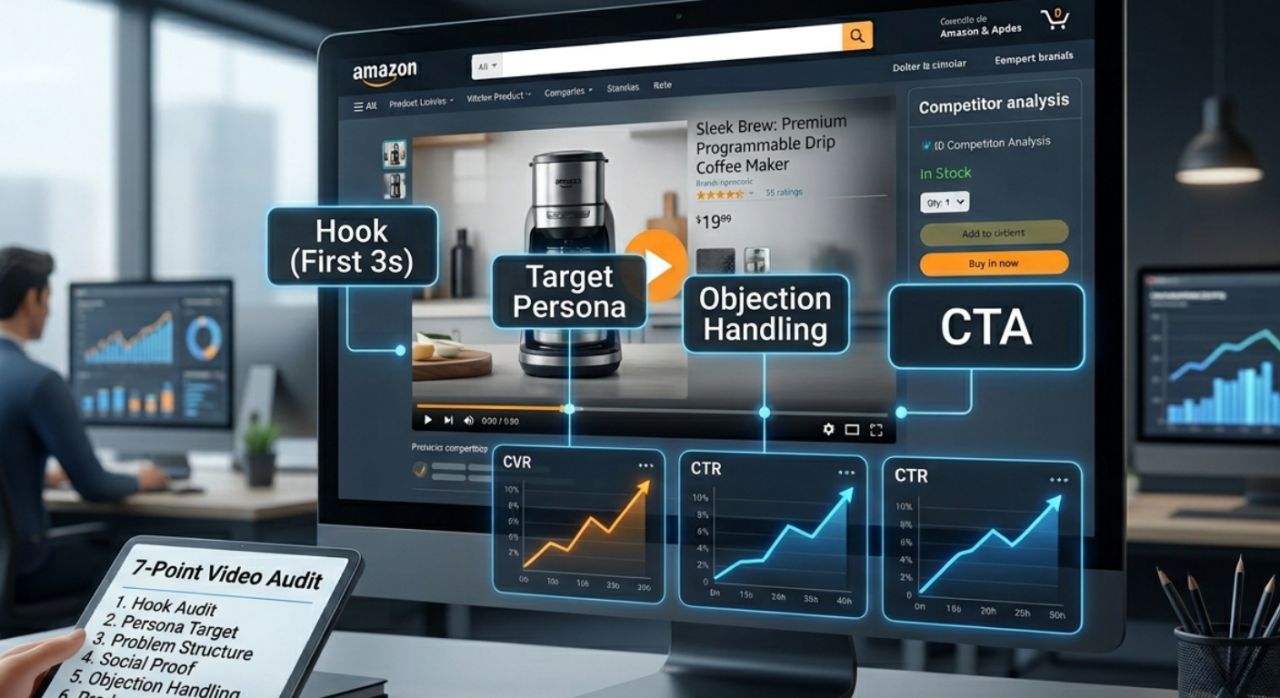
Step 2: The 7-Point Amazon Competitor Video Analysis Framework
──────────────────────────────────────────────────
For each competitor video, evaluate these seven elements systematically. Rate each as Strong, Average, or Weak, and add specific notes for each.
1. Hook — first 3 seconds What does their video lead with? A product shot, a lifestyle scene, a text overlay, or a problem statement? Does it immediately communicate the core benefit? This element, moreover, is the single highest-leverage point in any Amazon video because buyers decide within seconds whether to keep watching.
2. Buyer persona targeting Who is the video clearly made for? Is it targeting one specific buyer profile — gender, age, lifestyle, or use case — or is it generic? Generic targeting is the most common weakness found in Amazon competitor video analysis and, consequently, the easiest gap to exploit with persona-specific creative.
3. Problem-solution structure Does the video identify a buyer pain point before presenting the product as the solution? Or does it skip straight to product features? In most categories, videos that lead with the problem convert better because they mirror the buyer's internal thought process.
4. Social proof integration Does the video include customer testimonials, review callouts, or user-generated content? Furthermore, where is it placed — beginning, middle, or end? Social proof in the second half of a video typically outperforms social proof in the opening, because the buyer needs to understand the product before they are ready to be influenced by others' opinions.
5. Objection handling Does the video preemptively address the most common buyer hesitations for that product category? For a supplement brand, for example, this might be ingredient sourcing or third-party testing. For a kitchen tool, it is likely durability or ease of cleaning. If a competitor's video does not address the category's primary objections, their return rate is probably higher than it needs to be.
6. Production quality vs. price point Evaluate lighting, audio, color grading, and editing pace individually. Does the production quality match the price point of the product? A $120 product with a $30-looking video is leaving conversion on the table. Conversely, a $20 product with overproduced video signals a price-to-quality mismatch that makes buyers suspicious.
7. Call to action How does the video close? A product shot, a lifestyle image, a text CTA, or nothing at all? Does it create urgency, or does it simply end? Most competitor videos have weak closes — and the close is the last thing a buyer sees before deciding whether to add to cart.
▸ Scoring and Documenting Your Findings
After completing the 7-point Amazon competitor video analysis for each ASIN, total the scores and note the most significant individual weaknesses. Specifically, flag any element rated Weak across three or more competitors — those are your category-wide gaps. Additionally, note elements where the #1 ranked ASIN clearly outperforms all others, because those are likely the reason that listing is in position one.
Step 3: Pattern Recognition Across Competitors
──────────────────────────────────────────────────
Once you have audited 5–8 videos with this framework, look specifically for patterns across the full set.
What everyone is doing represents table stakes. If every top competitor uses lifestyle footage with a face model, for instance, you need that too. This is not where you win — but lacking it is where you lose.
What nobody is doing represents your opportunities. If no competitor video addresses a specific buyer objection that appears repeatedly in negative reviews, you have a conversion angle that is completely unoccupied in your category. This is rare — and therefore extremely valuable when you find it.
What the top performer does differently is worth reverse-engineering in detail. The #1 ranked ASIN has usually solved something the others have not. Is their hook stronger? Do they address a specific buyer persona more precisely? Is their social proof more credible or better placed? The answer, in most cases, is visible in the first ten seconds of their video.
The gap between "what everyone does" and "what nobody does" is, ultimately, where the best Amazon video creative is built. However, that insight is only useful if it produces specific, documented decisions before production begins.
Step 4: Translating Amazon Competitor Video Analysis Into Creative Decisions
──────────────────────────────────────────────────
Amazon competitor video analysis only creates value when it directly changes what you build. Here, therefore, is how to translate each finding into a production decision.
Weak hooks across competitors: Open your video with the buyer's problem stated visually in the first two seconds — no logo, no slow product pan. As a result, you capture attention before competitors do.
Generic audience targeting: Build persona-specific variants instead. A pet product category where every competitor shows a generic "happy dog owner" gets beaten, for example, by a video clearly made for French Bulldog owners or senior dog owners. Hyper-niche targeting consistently outperforms category-generic creative because it triggers identification — the buyer sees themselves, not a stranger, using the product.
Missing objection handling: Address the category's top three objections explicitly in your video. In doing so, you are not just showing a better product — you are showing that you understand the buyer's hesitations and have already answered them.
Weak or missing social proof: Include a credible customer testimonial in the second half of your video — ideally face-to-camera, from a buyer who matches your target persona. This single element, furthermore, often outperforms all other conversion levers when competitors rely only on star-rating callouts.
Identical visual styles across the category: Choose a deliberately different aesthetic. If every competitor uses bright studio lighting on white backgrounds, shoot on location instead. Visual differentiation drives higher CTR in Sponsored Brand Video placements — and, consequently, more organic rank data per ad dollar spent.
Step 5: Run Amazon Competitor Video Analysis Every 90 Days
──────────────────────────────────────────────────
One common mistake is treating Amazon competitor video analysis as a one-time, pre-launch activity. Sellers complete the audit, launch their video, and never look again.
The problem with this approach, however, is that competitors update their creative continuously. A brand with mediocre video in Q1 may have identified what converts by Q3 and refreshed everything. If you ran your audit months ago and haven't revisited, you are making creative decisions based on outdated intelligence.
As a result, the brands that consistently outperform in competitive categories run this analysis on a rolling basis — typically every 90 days per ASIN. They are not simply cataloguing what exists; they are tracking what changed, what new angles appeared, and where new gaps have opened.
▸ The Compound Advantage of Ongoing Competitive Audits
This rolling approach is one of the core reasons our monthly subscription clients outperform one-off production clients over a 12-month period. Specifically, every production cycle includes a fresh competitive audit, so the creative we build each month reflects what is happening in the category right now. The result is creative that compounds in effectiveness rather than plateauing after the initial launch.
Your 90-Minute Amazon Competitor Video Analysis Workflow
──────────────────────────────────────────────────
Here is a practical workflow for completing a full competitive audit from start to actionable brief.
Minutes 0–30: Pull the top 5–8 ASINs for your primary keyword. Watch each video once straight through, noting your overall impression.
Minutes 30–60: Run each video through the 7-point framework. Document scores and specific notes for all seven elements per ASIN.
Minutes 60–75: Run the pattern recognition exercise — identify what everyone does, what nobody does, and what the top performer does differently from the rest.
Minutes 75–90: Write 3–5 specific creative decisions your next video will make, directly derived from the audit findings. These become your production brief.
If you complete this Amazon competitor video analysis every 90 days per ASIN, you will invest roughly 6 hours per year per product in intelligence that improves every video you produce. That is, arguably, one of the highest-leverage time investments available in your Amazon business.
Ready to Turn Your Competitor Analysis Into Winning Creative?
──────────────────────────────────────────────────
At My Brand Videos, Amazon competitor video analysis is the first step in every production engagement. We do not produce creative without understanding what we are competing against — and, more importantly, where the gaps are that your video can fill.
If you want to see what a competitive video audit looks like for your specific category and top ASINs, start with a free listing review.
Book your free listing audit →
We will audit your current creative alongside your top 3 competitors' videos — and show you specifically what creative decisions would move your CVR based on what is working and what is missing in your category right now.lly what creative decisions would move your CVR based on what's working and what's missing in your category right now.
