How Video Impacts Amazon TACoS and Organic Rank
How Video Impacts Amazon TACoS and Organic Rank
Amazon TACoS video impact is one of the most misunderstood levers in competitive Amazon selling. Most sellers track TACoS every week — but almost none have connected the number they're staring at in their PPC dashboard to the quality of their listing video.
That disconnect is expensive. This article explains exactly how Amazon TACoS video impact works — how professional product video affects your TACoS and organic rank through a measurable mechanism you can act on today.
Amazon TACoS Video Impact: The Core Mechanism
──────────────────────────────────────────────────
ACoS tells you how efficiently your ads are converting. TACoS — Total Advertising Cost of Sales — tells you something more fundamental: what percentage of your total revenue is being consumed by advertising spend.
The formula is simple:
TACoS = Total Ad Spend ÷ Total Revenue × 100
A seller spending $10,000/month on PPC with $80,000 in total revenue has a TACoS of 12.5%. If that same seller grows total revenue to $120,000 without increasing ad spend, TACoS drops to 8.3%. The ads didn't get cheaper — the organic sales got stronger.
That's the entire game. And video is one of the most direct levers for moving it.
How Video Drives Amazon TACoS Video Impact: Two Compounding Paths
──────────────────────────────────────────────────
The connection between listing video and TACoS runs through two parallel paths that reinforce each other over time.
▸ Path 1: Video Improves CVR, Which Improves Organic Rank
Amazon's A9 algorithm ranks products based on their likelihood to generate a sale. The metric it uses as a proxy is conversion rate — specifically, unit session percentage.
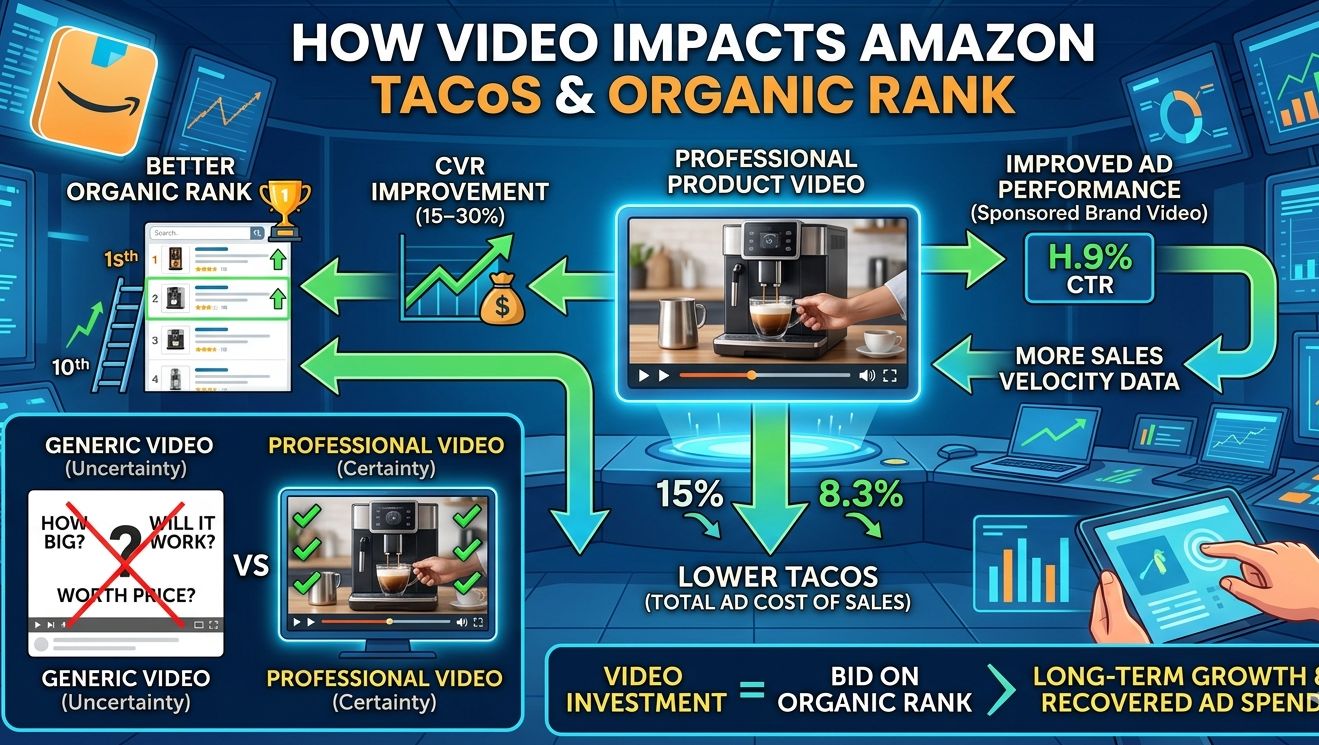
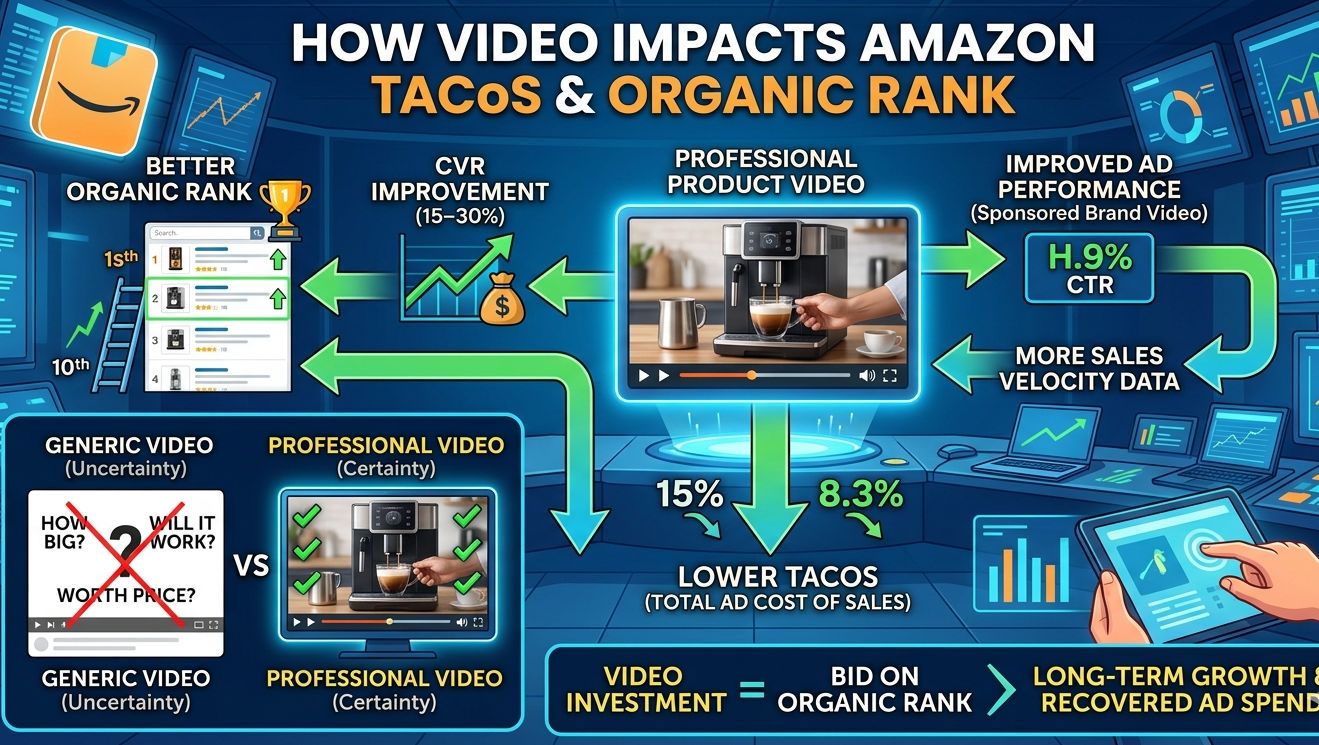
When a listing has professional video, CVR consistently improves. Sellers adding their first video to a mature listing typically see improvements between 15–30%. Sellers replacing low-quality video with professional production see 8–18% improvement.
Higher CVR signals to Amazon's algorithm that your listing converts better than competing listings for the same keywords. Amazon responds by ranking you higher organically — because a higher-ranking product means more revenue for Amazon, and that's always their incentive.
Higher organic rank means more impressions without additional ad spend. More impressions at the same CVR means more organic revenue. More organic revenue with the same ad budget means lower TACoS.
The mechanism: better video → higher CVR → better organic rank → more organic revenue → lower TACoS.
▸ Path 2: Video Ad Performance Builds Organic Rank Signals
Amazon Sponsored Brand Video ads consistently outperform static image ads in CTR across most categories. When your video ad drives a click and that click converts, Amazon records a sales velocity signal on that keyword.
Sales velocity is one of the strongest organic ranking signals in Amazon's algorithm. Every converting video ad click simultaneously improves paid performance and builds the organic rank signal for that keyword.
This compounding effect is what sellers running video at scale understand and sellers without video never experience. Your ads aren't just generating direct revenue — they're building organic rank that eventually generates revenue with zero additional ad spend.
What the Timeline Looks Like After Implementing Video
──────────────────────────────────────────────────
We don't have access to clients' Seller Central accounts — their PPC teams manage that data. But the pattern we hear consistently from brands after implementing professional video follows the same arc:
Month 1–2: CVR improves. Unit session percentage rises. Organic rank begins to climb on top converting keywords.
Month 3–4: Organic impressions increase. The ratio of organic to paid revenue starts shifting. TACoS begins to decrease even with constant ad spend.
Month 5–6+: The compounding Amazon TACoS video impact becomes clearly visible. Organic rank gains hold and grow. The brand generates more total revenue with the same or lower ad investment.
This isn't a guaranteed timeline — it varies by category competitiveness, ad spend level, and production quality. But the directional pattern is consistent: professional video starts a compounding cycle that paid spend alone cannot create.
Why Most Amazon Videos Don't Move TACoS
──────────────────────────────────────────────────
Not all video produces this effect. Generic video — stock footage, template animations, products on white backgrounds with stock music — doesn't move CVR meaningfully because it doesn't change the buyer's decision-making process.
For video to drive meaningful Amazon TACoS video impact, it has to do one specific thing: reduce buyer uncertainty at the moment of decision.
Buyer uncertainty looks like:
• "I'm not sure how big this actually is"
• "I don't know if this will work for my specific use case"
• "I can't tell if this is worth the price"
• "I've been burned before buying something like this"
A video that answers those objections visually — showing the product in context, demonstrating function, communicating quality through production value — converts. A video that doesn't address those objections is decoration.
This is why the script matters as much as the production. A beautifully shot video that doesn't address the buyer's core uncertainty won't move CVR and won't move TACoS. A well-scripted video that speaks directly to the buyer's decision will.
A/B Testing Creative to Maximize TACoS Improvement
──────────────────────────────────────────────────
If a single video can improve CVR and begin moving TACoS, multiple tested variants can accelerate that effect significantly.
A/B testing creative for TACoS isn't about testing what looks better. It's about testing which creative angle generates the highest CVR across the specific buyer segments reaching your listing — then using the winning variant to compound the organic rank signal as efficiently as possible.
Buyer persona framing. A pet product targeting "active dog owners" in one video and "senior dog owners" in another generates different CVR signals from different buyer segments. The winning persona becomes the primary creative for the keywords that segment searches most.
Product use case emphasis. Leading with the primary use case versus a secondary one generates measurably different conversion rates depending on the traffic source. Testing this tells you which use case resonates with actual buyers, not assumed buyers.
Thumbnail and hook. The first frame and first three seconds determine whether a buyer engages at all. Testing different hooks — benefit-led versus problem-led, product-forward versus lifestyle — drives meaningful differences in play rate and the engagement signal Amazon records for your listing.
The sellers compounding TACoS improvements over time aren't running one video. They're running a testing cycle that continuously identifies higher-converting creative and updates their listings accordingly.
What to Measure to Track Amazon TACoS Video Impact
──────────────────────────────────────────────────
You can't improve what you don't measure. To track Amazon TACoS video impact across your listings, watch these metrics across two systems:
In Amazon Brand Analytics and Seller Central:
• Unit session percentage (CVR) — track weekly before and after video implementation
• Organic vs. paid revenue split — this ratio shifting toward organic is the clearest TACoS improvement signal
• Keyword rank on your top 5–10 converting terms — organic rank movement is the leading indicator of TACoS improvement before the revenue shift is visible
In your PPC campaign data:
• Sponsored Brand Video CTR vs. static ad CTR — video should outperform by a meaningful margin
• Converting keyword list — keywords generating sales through video ads are the ones most likely to see organic rank improvement from video-driven sales velocity
The signal to watch most closely is the organic-to-paid revenue ratio. When that shifts — even before TACoS visibly drops — the mechanism is working.
The Video Investment vs. TACoS Reduction Math
──────────────────────────────────────────────────
A seller doing $150,000/month in total revenue with $22,500 in ad spend has a TACoS of 15%. If professional video improves CVR and organic rank enough to shift the organic/paid revenue ratio — moving TACoS from 15% to 11% — that represents $6,000/month in recovered ad spend.
At $6,000/month recovered, that's $72,000 annually. A professional video investment pays for itself many times over before the end of year one. And unlike a one-time listing fix, the compounding organic rank effect grows as long as the content remains competitive.
This is why sellers at 7 and 8 figures treat video as infrastructure, not a marketing expense. The TACoS math makes the investment obvious once you understand the mechanism.
What This Means for Your Creative Strategy
──────────────────────────────────────────────────
Understanding Amazon TACoS video impact changes how you think about your creative budget.
Video isn't a cost. It's a bid on organic rank. Every dollar invested in professional video that improves CVR is a dollar that permanently reduces the ad spend required to generate the same revenue.
If you're spending $15,000+/month on PPC and don't have professional video on your top ASINs, you're leaving organic rank on the table that your ad spend is paying for but not capturing. Every week without video is a week your competitors are building rank signals you're not.
The brands pulling ahead in competitive Amazon categories aren't just outspending on PPC. They're building organic rank through CVR — and video is the highest-leverage tool for doing that.
Ready to Start Moving Your TACoS?
──────────────────────────────────────────────────
At My Brand Videos, we build Amazon product video and AI-hybrid creative testing systems for 6–8 figure sellers. Every asset is built around a specific conversion goal — not around what looks good in a reel.
If your TACoS has been flat or climbing and your creative hasn't changed in the last 90 days, that's the place to start.
We'll review your top ASINs, identify where video can move your CVR and organic rank, and walk you through what a creative testing strategy looks like for your specific category and ad spend level.
