Amazon Listing Video Length: Data and Best Practices
Amazon Listing Video Length: Data and Best Practices
Amazon listing video length is one of those questions every seller asks and almost nobody answers with real data. The honest answer is that it depends — but it depends on specific, identifiable factors, not guesswork.
This guide breaks down Amazon listing video length by placement, category, and buyer intent, so you can make a decision based on evidence rather than an arbitrary industry rule of thumb.
Why There's No Single Correct Amazon Listing Video Length
Most advice online gives a flat answer like "keep it under 60 seconds." That guidance isn't wrong, exactly, but it's incomplete. The correct length depends heavily on where the video lives, what the buyer already knows, and how considered the purchase decision is.
A $15 kitchen gadget and a $200 fitness device serve completely different buyer journeys. The first is often an impulse purchase where a buyer wants quick confirmation that the product looks legitimate. The second typically involves more research, comparison shopping, and a longer decision window. Consequently, the video length that serves each buyer well is fundamentally different.
This is why testing — not a universal rule — is the only reliable way to find the right Amazon listing video length for your specific product.
What the General Data Suggests
That said, broad patterns do exist across thousands of Amazon listings. Main listing videos between 45 and 90 seconds tend to perform best across most categories. Below 45 seconds, there often isn't enough time to address buyer objections or build sufficient trust. Above 90 seconds, completion rates drop sharply for most product types, meaning the back half of the video goes largely unwatched.
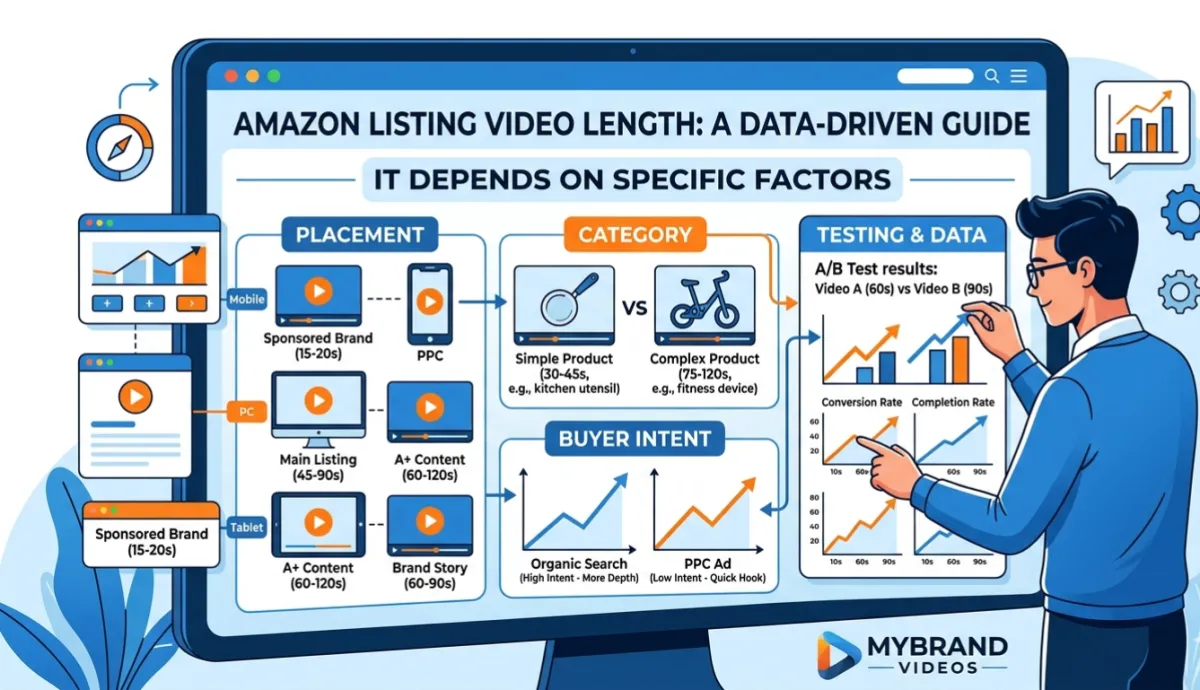
Amazon Listing Video Length by Placement
Length should vary based on where the video appears, because each placement serves a different function in the buyer journey.
Main listing video (hero position). This is typically the first video a buyer encounters. The ideal range here is 45–90 seconds — long enough to introduce the product, demonstrate function, and include a testimonial or proof element, but short enough to avoid significant drop-off before the key information lands.
A+ Content video modules. Because buyers reaching A+ Content have already scrolled past the main image and bullet points, they're demonstrating higher engagement. This allows for slightly longer content — 60–120 seconds — particularly for products with more complex setup or use cases that benefit from additional explanation.
Sponsored Brand Video ads. PPC video has a much shorter effective window because it's competing for attention in a search results feed rather than on a listing page the buyer chose to visit. Here, 15–20 seconds is the sweet spot. Anything longer sees a significant decline in completion rate within the ad placement itself.
Brand Story video. This is your most flexible placement length-wise, since buyers engaging with Brand Story content are typically deep in the consideration phase. Videos of 60–90 seconds work well here, focusing on brand credibility and narrative rather than direct product demonstration.
How Product Category Affects Amazon Listing Video Length
Category complexity is the second major variable, and it interacts directly with placement.
Simple, well-understood products — kitchen tools, basic accessories, everyday consumables — perform best with shorter videos. Buyers already understand the product category, so the video's job is mainly to confirm quality and build trust quickly. A 30–45 second video often outperforms a longer one for these categories because it respects the buyer's limited need for explanation.
Complex or unfamiliar products — fitness equipment with multiple functions, electronics with several features, anything requiring assembly or setup — benefit from longer content. Buyers in these categories have more questions, and a video that proactively answers them reduces both purchase hesitation and post-purchase returns. For these products, 75–120 seconds is often appropriate, particularly within A+ Content where engaged buyers are willing to invest more time.
Considered, higher-price purchases — supplements with health claims, premium home goods, professional-grade tools — sit in between. These buyers want thoroughness but still have limited patience. A 60–90 second main video paired with a longer A+ Content video for those who want more detail tends to serve both buyer types well.
Buyer Intent and Amazon Listing Video Length
The third variable, buyer intent, often gets overlooked entirely in length discussions.
A buyer arriving from an organic search for a specific product name already has high purchase intent and less need for extensive education. A buyer arriving from a broad category search or a Sponsored Brand ad has lower intent and needs more persuasion before they're ready to commit.
This means the same product might warrant different video lengths depending on traffic source. The PPC video targeting broad, low-intent keywords should be tight and benefit-led. The listing video that high-intent organic traffic encounters can afford more depth, because that buyer is already closer to a purchase decision.
Practical Application
If your PPC traffic and organic traffic see the same main listing video, you're potentially under-serving one audience or the other. Sellers running A/B tests with different video lengths for different traffic sources — where Amazon's tools allow it — typically uncover meaningful differences in performance.
How to Test for Your Ideal Amazon Listing Video Length
Rather than relying on category benchmarks alone, the most reliable path is structured testing specific to your product and audience.
Start by producing two versions of your main listing video — one in the 45–60 second range and one in the 75–90 second range, covering the same core content but with the longer version including additional detail or a testimonial segment. Run both for a minimum of four weeks with sufficient traffic to reach statistical relevance.
Track two metrics specifically: conversion rate and, where available through your analytics, video completion rate. If the shorter video converts similarly but has a meaningfully higher completion rate, it's likely the more efficient choice. If the longer video shows a clear conversion advantage despite lower completion, the additional content is doing real persuasive work for the buyers who do watch it.
Signs Your Current Video Is the Wrong Length
A few patterns suggest your existing video length may be hurting conversion rather than helping it.
If your analytics show steep drop-off in the first 10 seconds, the issue usually isn't length — it's the hook. However, if completion rate is reasonable through the first half and then drops sharply, your video may simply be too long for the content it contains, and trimming the back half could improve overall performance.
Conversely, if your video is short but your category has a high rate of return-driven complaints about size, function, or compatibility, that's a signal the video needs more content, not less — even if it means a longer runtime.
Bringing It Together: A Length Framework You Can Apply Today
For most 6–8 figure Amazon sellers, this framework provides a solid starting point before testing refines it further:
Main listing video: 60–75 seconds for most categories, adjusted toward 45 seconds for simple products and toward 90 seconds for complex ones.
A+ Content video: 60–120 seconds, leveraging the higher engagement of buyers who've scrolled this far.
Sponsored Brand Video: 15–20 seconds, optimized for immediate hook and quick benefit communication.
Brand Story: 60–90 seconds, prioritizing narrative and credibility over direct demonstration.
These ranges are starting points, not final answers. The sellers who consistently outperform their category aren't relying on a published benchmark — they're testing length against their own data and adjusting from there.
Ready to Build Video at the Right Length for Your Category?
At My Brand Videos, every video we produce starts with a clear understanding of placement, category complexity, and buyer intent — which means length is a deliberate creative decision, not a guess.
If you're unsure whether your current video length is helping or hurting your conversion rate, that's exactly what a listing audit is for.
We'll review your current video against your category and traffic sources, and show you specifically where length adjustments could move your CVR.
Related articles:
