Amazon Product Photography Video Integration Guide
Amazon product photography video integration is one of the most overlooked strategies in listing optimization — and one that separates brands that look professional from brands that look polished and intentional. Most sellers treat photography and video as separate projects, sourced from different vendors at different times. The result, however, is a listing where the visual language shifts mid-scroll, creating subtle friction that erodes buyer trust without any obvious cause.
This guide explains exactly why Amazon product photography video integration matters, how to execute it correctly, and what unified visual creative does for conversion that disconnected assets cannot.
Why Amazon Product Photography Video Integration Matters
When a buyer scrolls through an Amazon listing, they're processing visual information continuously. The main image sets an expectation. The gallery images build on that expectation. The listing video either reinforces or disrupts it. The A+ Content either completes the visual story or introduces another visual shift.
Every time the visual language changes — different lighting, different color palette, different lifestyle context, different tone — the buyer's brain registers an inconsistency. Most buyers can't articulate why a listing feels "off," but that inconsistency is precisely why. Consequently, trust erodes in ways that no amount of strong copy can fully repair.
This is the core argument for Amazon product photography video integration: unified visual creative removes that friction and allows every asset to reinforce rather than undermine the others.
The Compounding Effect of Visual Cohesion
Additionally, visual cohesion across photography and video creates a compounding trust effect that's difficult to achieve through either asset type alone. A buyer who sees consistent lighting, consistent color language, consistent lifestyle context, and consistent brand personality across all listing visuals develops a stronger sense of brand credibility — even if they can't identify exactly why.
This effect is particularly powerful for premium products and considered purchases, where perceived brand quality directly influences whether the price feels justified.
The Most Common Visual Disconnect Problems
Before addressing how to execute Amazon product photography video integration correctly, it's worth identifying the specific disconnects that appear most frequently in high-volume listings.
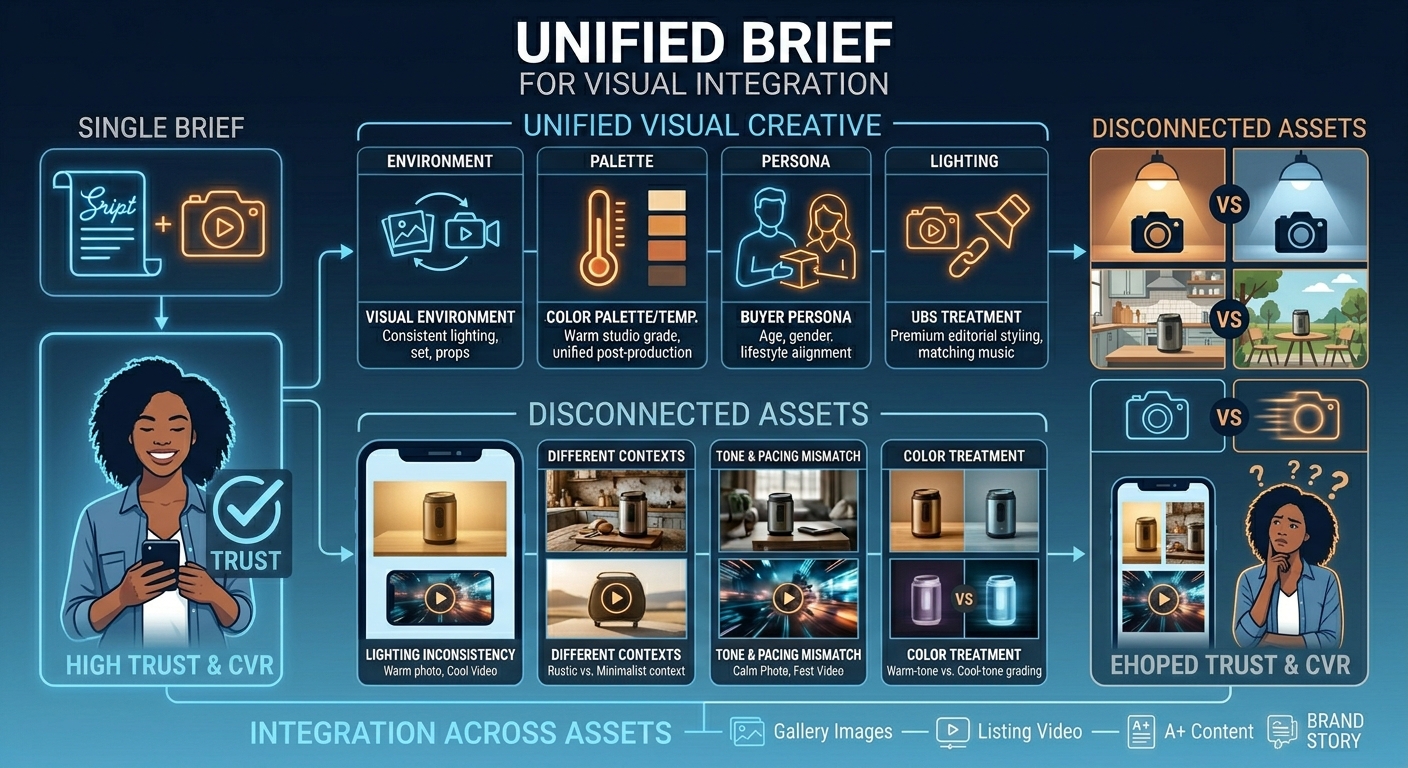
Lighting inconsistency. Photography shot with warm studio lighting and video shot in a cool outdoor environment creates an immediate visual shift that makes the product appear different in each format. Buyers who notice this — consciously or not — develop uncertainty about what the product actually looks like.
Different lifestyle contexts. Photography showing the product in a modern, minimalist kitchen and video showing the same product in a rustic outdoor setting tells two different brand stories. Each context implies a different buyer persona, and the resulting confusion leaves neither persona fully served.
Tone and pacing mismatch. Photography with a quiet, premium, editorial feel paired with video that's fast-paced and energetic creates a brand identity conflict. The listing feels like it belongs to two different companies, which undermines the credibility of both visual approaches.
Color treatment differences. Different color grading between photography and video is one of the subtler disconnects, but it's also one of the most damaging for premium products where color accuracy is a purchase driver. If the product appears warmer in photos and cooler in video, return rates from color-related expectations increase.
How to Execute Amazon Product Photography Video Integration
Achieving genuine visual integration requires one foundational decision that most sellers never make explicitly: the creative direction for photography and video must be defined in a single brief before either is produced.
The Unified Creative Brief
A unified creative brief for Amazon product photography video integration covers four elements that both photography and video must be held to consistently.
Visual environment. Define the specific physical environments — both studio and lifestyle — that will appear across all assets. If photography will use a natural wood surface, video must use the same or a directly compatible surface. The visual world should feel like one coherent place, not a collection of different sets.
Color palette and temperature. Define the color grading direction before production begins — warm or cool, saturated or muted, high contrast or soft. Apply the same grading direction in post-production for both photography and video so the product reads consistently across all formats.
Buyer persona. Define exactly who appears in the lifestyle content — age range, gender, lifestyle context, relationship to the product. That persona should be consistent across every lifestyle photo and every video frame that includes a human subject.
Tone and pacing. Define the brand's emotional register — premium and quiet, energetic and approachable, authoritative and technical, warm and personal. That tone should be reflected in the styling, the models' body language, the music choice in video, and the prop selection in photography.
When photography and video are produced against the same brief, the resulting assets integrate naturally. When they're produced separately without a shared direction, integration requires extensive post-production correction that rarely fully resolves the original disconnect.
Why Producing Photography and Video Together Produces Better Results
Beyond creative consistency, there are practical production advantages to executing Amazon product photography video integration in a single production engagement.
Efficiency. When the same crew, same set, and same models are used for both photography and video in a single production day, the cost per asset is meaningfully lower than two separate productions. Setup time, model fees, location costs, and art direction time are all shared rather than duplicated.
Natural consistency. When photography and video are shot on the same day in the same environment, consistency isn't something that needs to be enforced in post-production — it happens naturally. The lighting is the same because it's the same light. The color temperature matches because it's the same set. The model looks the same in both because it's the same person on the same day.
Faster testing cycle. When all visual assets are ready simultaneously, A/B testing can begin immediately rather than waiting for a second production round. Furthermore, insights from the first testing cycle inform any future production more clearly when all original assets share the same visual foundation.
Amazon Product Photography Video Integration Across the Full Listing
Applying visual integration across a complete listing means thinking through every placement where visual content appears.
Main image and video thumbnail. The main image and the video thumbnail are often the two most viewed visuals on the listing. They should share visual language clearly enough that a buyer who sees both recognizes them as belonging to the same brand without any conscious effort.
Gallery images and video content. Each gallery image should correspond thematically to a segment of the video — the same use cases, the same environments, the same buyer types. A buyer who watches the video and then scrolls through the gallery should feel like the gallery is expanding on what the video showed, not introducing a separate visual world.
A+ Content and Brand Story. A+ Content and Brand Story modules should complete the visual story established by the gallery and video, using the same color language, the same lifestyle contexts, and the same persona representation. When all four elements align, the buyer's experience of the listing is immersive rather than fragmented.
Measuring Whether Integration Is Improving Conversion
Visual integration is ultimately about conversion — and it's measurable, even if the mechanism is indirect.
The most direct signal is return rate. When photography and video create accurate, consistent expectations, buyers receive exactly what they expected — which means fewer returns driven by mismatched expectations. A meaningful drop in return rate after a unified creative refresh is one of the clearest signals that visual integration is working.
Additionally, watch session duration on the listing page. Buyers who experience visual coherence tend to engage with more of the listing before making a decision, which typically correlates with higher purchase confidence and lower post-purchase regret.
Ready to Integrate Your Amazon Photography and Video?
At My Brand Videos, Amazon product photography video integration is how we approach every full listing package. Photography and video are produced together, against a unified creative brief, so every asset that goes live reinforces the others.
If your current listing has visual disconnects between photography and video — different lighting, different lifestyle contexts, or inconsistent brand tone — a unified production is likely the most efficient path to closing the conversion gap.
We'll review your current assets and identify specifically where visual disconnects are creating friction in your buyer's listing experience.
Related articles:
