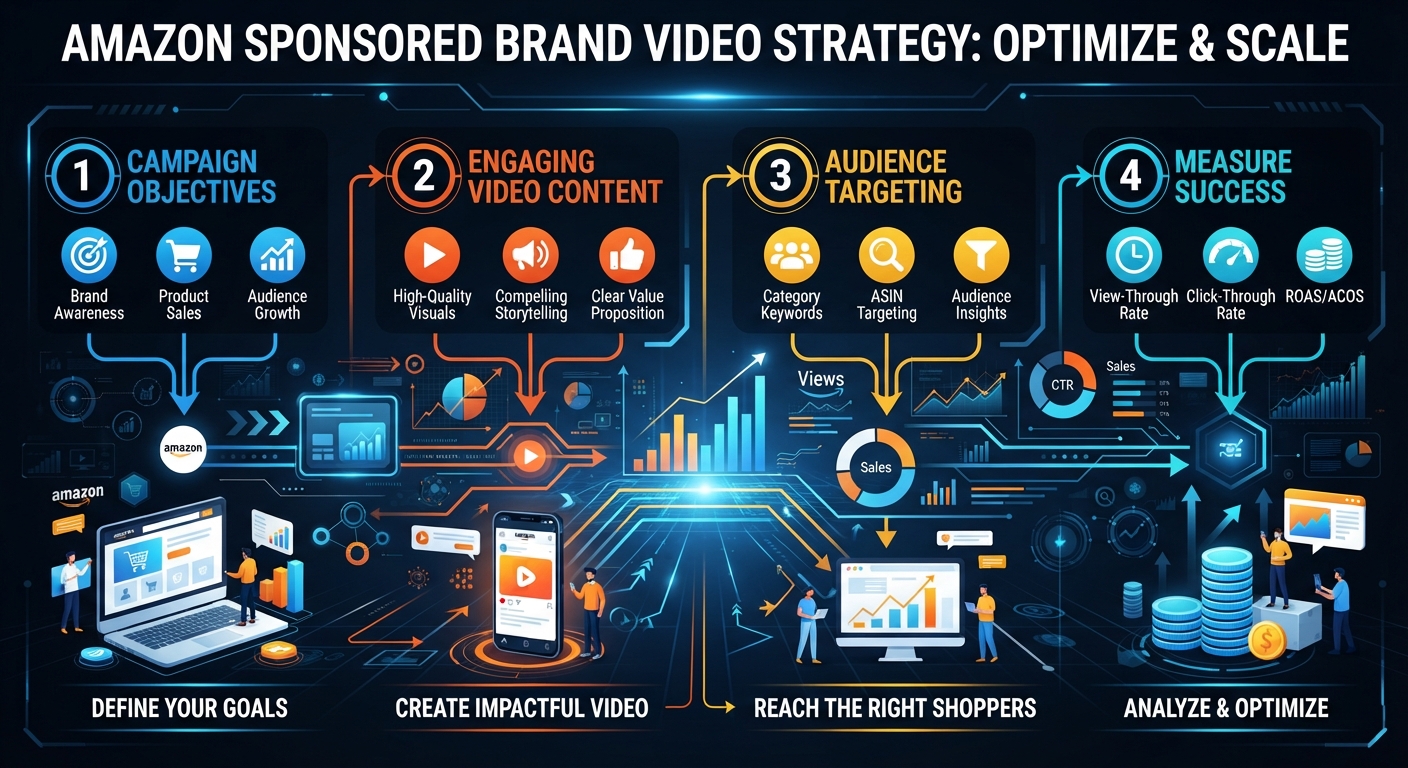
Amazon Sponsored Brand Video: Strategy That Wins in 2026
Amazon Sponsored Brand Video is the most strategically underutilized ad format available to Amazon sellers — not because sellers aren't running it, but because most are running it as a pure PPC play without leveraging the organic rank contribution that makes it the most dual-return investment in the Amazon advertising toolkit.
This guide covers Amazon Sponsored Brand Video strategy end to end: how to brief and produce SBV creative, how to target campaigns for maximum organic rank contribution alongside direct revenue, and what the metrics tell you about whether your strategy is working.
Why Amazon Sponsored Brand Video Is a Dual-Return Investment
Every Amazon seller who runs PPC understands the direct return: ad spend generates clicks, clicks convert, conversions generate revenue. Sponsored Brand Video does this like any other ad format. However, it simultaneously generates something that most other ad formats don't: keyword-level sales velocity signals that feed directly into Amazon's organic ranking algorithm.
When a Sponsored Brand Video ad drives a click and that click converts, Amazon records a sale attributed to the keyword that triggered the ad display. Sales velocity on a keyword is one of the primary inputs into Amazon's A9 ranking algorithm. Consequently, a well-targeted Sponsored Brand Video campaign is simultaneously generating direct ad revenue and building the organic rank signal for the keywords you're targeting.
This dual return is why Amazon Sponsored Brand Video deserves a different strategic framing than standard Sponsored Products campaigns. The question isn't only "what's my ACoS?" — it's "what organic rank am I building on my priority keywords at this ACoS, and what's that rank worth in perpetual organic traffic?"
Why Most SBV Campaigns Underperform This Potential
Most sellers who run Sponsored Brand Video campaigns target the same keywords as their Sponsored Products campaigns without adjusting creative strategy for the format. Sponsored Products ads display static images in a feed that buyers are accustomed to ignoring. Sponsored Brand Video ads display autoplay video in the same feed — which means the creative requirements for stopping the scroll, capturing attention without sound, and communicating the core benefit in the first two seconds are fundamentally different. Applying static ad thinking to video ad creative produces video ads that behave like slightly more expensive static ads.
The Creative Brief for Amazon Sponsored Brand Video
Because SBV appears in search results rather than on a listing page, the creative brief is fundamentally different from a listing video brief.
The hook must work without sound and without context. The buyer encountering a Sponsored Brand Video ad is not on your listing page — they're in a search results feed looking at multiple results simultaneously. Your video begins playing automatically, without their consent. The first two seconds must stop that scroll without requiring the buyer to consciously decide to engage. Text overlays, immediate product visual, and motion that communicates relevance to the search query are the tools available in this window.
The benefit must land in 15 seconds. Sponsored Brand Video ads perform best at 15 to 20 seconds because buyers in a search feed have a low tolerance for extended content they didn't choose to watch. The entire persuasive job — hook, product, primary benefit, implicit CTA — needs to fit within that window without feeling rushed.
The creative should match the keyword's buyer intent. A buyer searching a broad category term has different intent than a buyer searching a specific product name. SBV creative that matches the specificity of the keyword it's targeting performs better than generic brand creative applied across the full keyword set. Therefore, producing multiple SBV variants targeting different intent levels in the keyword hierarchy typically outperforms a single creative running across all targets.
Targeting Strategy for Amazon Sponsored Brand Video
Campaign targeting for SBV should be built around two parallel objectives: direct revenue efficiency and organic rank contribution.
For direct revenue efficiency, target keywords with proven conversion history from your Sponsored Products data. These are keywords where buyers are already finding your product relevant enough to purchase — meaning SBV creative targeting them will generate a predictable return based on established conversion rates.
For organic rank contribution, target the keywords where you want to improve organic position but currently rank too low to generate significant organic traffic. These may have higher CPCs and lower initial conversion rates, but each converting click builds the sales velocity signal for that keyword. Over time, sufficient sales velocity moves organic rank, which then generates organic traffic at zero additional cost.
The optimal campaign structure maintains separate campaigns for these two objectives so the metrics for each can be tracked and optimized independently — preventing efficiency-focused optimization from eliminating the rank-building targeting that generates long-term value.
Metrics That Tell You Whether Your SBV Strategy Is Working
Standard PPC metrics — ACoS, ROAS, CPC — tell you the direct revenue story for Sponsored Brand Video. However, the full strategic picture requires additional metrics.
CTR by keyword. Low CTR on a specific keyword indicates either that the creative isn't stopping the scroll for buyers with that intent, or that the creative doesn't match the buyer's expectation for that search. Targeting the same keyword with different creative variants and comparing CTR is the clearest way to identify which creative angle resonates with which buyer intent.
Organic rank movement on targeted keywords. Track keyword rank position monthly for the terms your SBV campaigns are targeting. Organic rank improvement on a keyword where SBV campaigns have been consistently active confirms that the sales velocity contribution is accumulating as intended. Rank movement on SBV-targeted keywords at a higher rate than non-targeted keywords is the clearest evidence the dual-return strategy is working.
Video completion rate. Where analytics tools provide SBV-specific completion data, completion rate tells you whether buyers are watching through the benefit communication or dropping off before the primary message lands. Drop-off in the first 5 seconds consistently indicates a hook problem rather than a content problem.
Amazon Sponsored Brand Video in the Full Creative System
SBV doesn't operate in isolation from your listing video strategy. The creative angle that wins in SBV testing — the hook, the benefit framing, the buyer persona it resonates with — often reflects the same creative angle that should be tested in the main listing video.
Conversely, the objections that SBV traffic fails to convert on (revealed by high CTR with low conversion) point to listing-level issues that listing video testing should address. This feedback loop between SBV performance data and listing creative decisions is one of the clearest examples of how a coordinated video strategy outperforms a collection of independently managed assets.
Ready to Build an Amazon Sponsored Brand Video Strategy?
At My Brand Videos, we produce SBV creative as part of our full listing packages — briefed specifically for the search feed context, produced at the right length, and connected to the same creative strategy driving listing video and A+ Content decisions.
Related articles:
