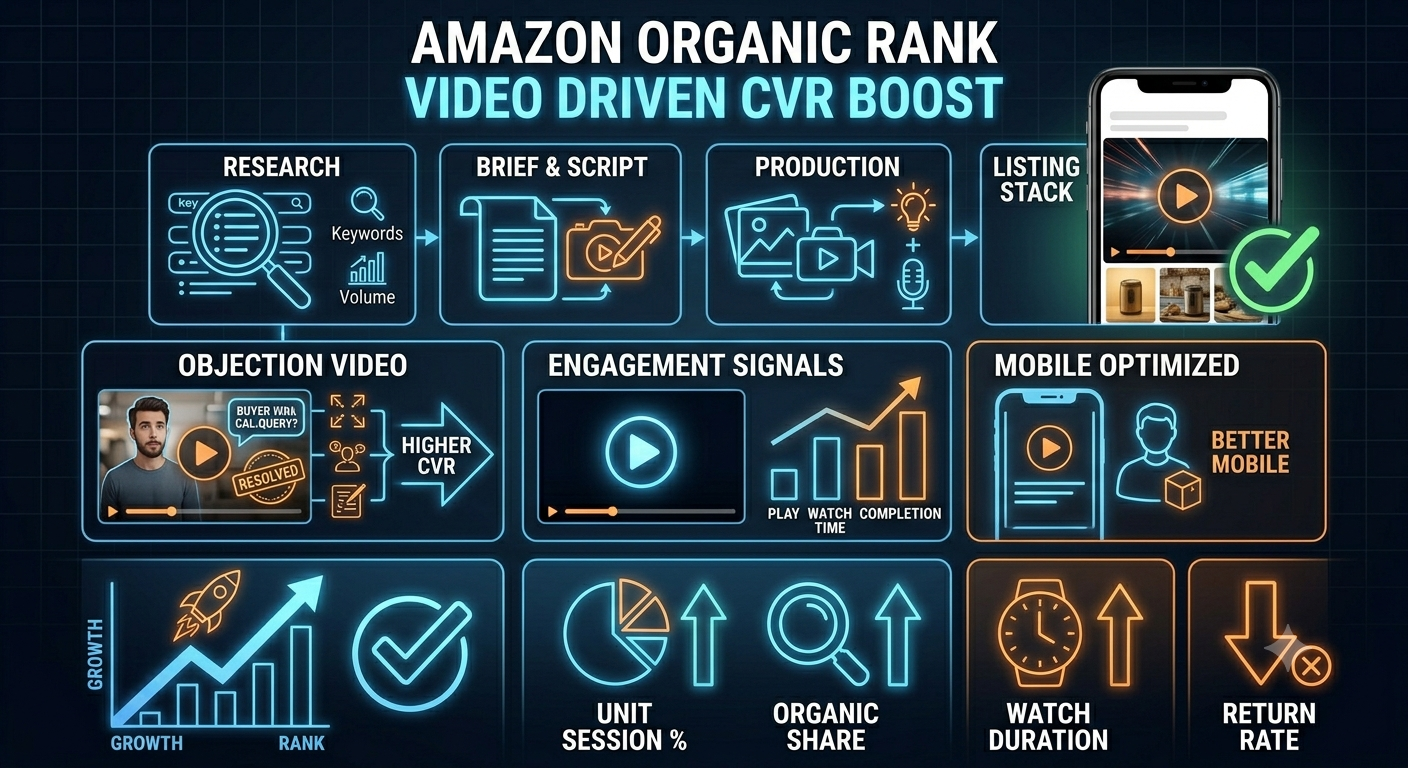
Amazon Organic Rank Video: How Creative Drives Ranking
Amazon organic rank video strategy is the missing link for sellers who have optimized everything else on their listing — title, bullets, backend keywords — and still can't move past page two for their most valuable search terms. The piece they're missing usually isn't more keyword stuffing. It's video built specifically to influence the signals Amazon's algorithm actually rewards.
This guide explains the real mechanism behind improving Amazon organic rank with video content, what specifically moves the needle, and how to build a video strategy around ranking rather than just aesthetics.
Why Amazon Organic Rank Video Strategy Starts With Understanding A9
Amazon's ranking algorithm, commonly referred to as A9, doesn't rank listings based on keyword density or how attractive the images look. It ranks based on one core question: how likely is this listing to generate a sale when shown to a relevant buyer?
That likelihood is measured primarily through conversion rate — specifically, unit session percentage. A listing that converts a higher percentage of its visitors into buyers signals to Amazon that showing this product more often will generate more revenue. Since Amazon's business model depends on maximizing sales, the algorithm responds by ranking higher-converting listings above lower-converting ones for the same search terms.
This is the foundation that makes Amazon organic rank video strategy effective. Video doesn't directly tell Amazon's algorithm "rank me higher." Instead, video improves conversion rate, and conversion rate is what the algorithm actually uses as its ranking signal.
Why Keyword Optimization Alone Has a Ceiling
Most sellers focus heavily on keyword optimization — title structure, backend search terms, bullet point density. These elements matter for relevance matching, meaning Amazon understands what your product is and when to show it. However, relevance alone doesn't determine rank position among multiple relevant listings. Conversion rate does that. This is precisely why two listings targeting the same keywords with similar relevance can rank very differently — the higher-converting listing wins the position.
The Two Mechanisms Behind Amazon Organic Rank Video Strategy
Video influences organic rank through two distinct but related mechanisms that compound over time.
Mechanism one: direct conversion improvement. When a listing adds professional video, conversion rate typically improves measurably — often between 15 and 30 percent for listings adding their first video. That improved conversion rate is immediately visible to Amazon's algorithm through standard performance tracking, and rank improvements on relevant keywords often follow within several weeks.
Mechanism two: engagement signal accumulation. Beyond direct conversion, video generates engagement data that static images cannot — play rate, watch time, and completion rate. While Amazon hasn't publicly confirmed exactly how these signals factor into ranking, sellers consistently observe that listings with higher video engagement show stronger organic performance over time, suggesting these signals contribute meaningfully to the algorithm's broader assessment of listing quality.
Together, these mechanisms create a compounding effect. As conversion improves and engagement data accumulates, organic rank strengthens — which increases organic traffic, which generates more conversion data, which further reinforces the improved ranking position.
What Kind of Video Actually Moves Organic Rank
Not all video produces this effect equally. Generic, low-effort video rarely moves conversion enough to influence ranking meaningfully.
Video that addresses real buyer objections drives the strongest conversion improvement, and therefore the strongest organic rank impact. If your category has a recurring concern in negative reviews — sizing, durability, ease of use — video that directly resolves that concern converts measurably better than video that simply shows the product looking attractive.
Video with strong opening hooks matters because Amazon tracks engagement signals like play rate. A video that loses viewers in the first three seconds generates weak engagement data regardless of how good the remaining content is. The opening, therefore, deserves disproportionate creative attention relative to its length.
Video optimized for mobile viewing is essential because the majority of Amazon traffic is mobile, and video that's hard to follow on a small screen — too much text, too-small product details — underperforms regardless of production quality on desktop.
Building an Amazon Organic Rank Video Strategy Around Your Top Keywords
The most effective approach connects video production decisions directly to the specific keywords you're trying to rank for, rather than treating video as a generic listing enhancement.
Step One: Identify Your Priority Keywords
Start with the 5 to 10 keywords driving the most potential revenue to your category — high search volume, strong purchase intent, and keywords where you're currently ranking on page two or the bottom of page one. These are the keywords where a conversion rate improvement has the clearest path to meaningful rank movement.
Step Two: Audit What's Currently Converting for Those Keywords
Look at the top-ranking listings for each priority keyword. What video elements do they have? What objections does their video address? This audit tells you what conversion bar you need to clear to compete for that ranking position.
Step Three: Build Video Specifically Targeting Those Conversion Gaps
Rather than producing one generic video for your entire listing, build video content that specifically addresses what's preventing conversion for your priority keyword's buyer intent. A buyer searching a broad category term has different needs than a buyer searching a specific product name — and video that speaks to the specific intent behind your priority keywords converts better than generic content.
Measuring Whether Your Video Strategy Is Improving Organic Rank
Tracking the relationship between video and organic rank requires monitoring a few specific metrics consistently over time.
Keyword rank position. Track your priority keywords weekly using Amazon's own ranking data where available, or a third-party rank tracking tool. Rank improvements following a video update are the clearest direct evidence the strategy is working.
Unit session percentage by traffic source. Compare conversion rate before and after video implementation, ideally isolating organic traffic specifically since that's the segment most directly tied to algorithmic ranking decisions.
Organic impression share. As rank improves, your listing should appear in more search results for the same keywords without any change in ad spend. A growing impression share on your priority keywords is a strong leading indicator that organic rank is strengthening, often visible before the rank position change is fully reflected in search results.
Why This Compounds Over Time
The relationship between video and Amazon organic rank video strategy isn't a one-time boost — it's a compounding cycle that strengthens with consistent attention.
As organic rank improves, the listing receives more organic traffic. More organic traffic, at the same conversion rate, generates more total sales velocity on that keyword. Sales velocity is itself a ranking signal, which reinforces the improved position further. Meanwhile, the additional traffic generates more review volume and more engagement data, both of which contribute to sustained ranking strength.
This is why sellers who treat video as an ongoing strategy — testing, refining, and updating based on what's working — see organic rank improvements that continue to build over many months, while sellers who produce one video and never revisit it typically see an initial improvement that eventually plateaus.
Ready to Build Video That Moves Your Organic Rank?
At My Brand Videos, every production we create starts with an understanding of which keywords matter most to your business and what conversion gap is currently holding back your organic rank on those terms.
If you've optimized your listing copy and backend keywords but still aren't ranking where your category competitors are, video built around your specific conversion gaps is often the missing piece.
We'll review your priority keywords, your current rank position, and show you specifically what a video strategy built around closing your conversion gap would look like.
Related articles:
