Amazon Video Agency vs. In-House: Which Is Right for You
The choice between an Amazon video agency and in-house production is one that most Amazon sellers make by default rather than by deliberate evaluation. They hire an agency because they don't have internal capability, or they build internal capability because they've had bad agency experiences — without working through the honest tradeoffs that should drive the decision at their specific revenue level and operational context.
This guide covers the real tradeoffs between Amazon video agency and in-house production — not the version each side would prefer you hear, but the actual comparison at different revenue levels, content volumes, and strategic contexts.
The Case for Amazon Video Agency at Different Revenue Stages
At the 6-figure level ($100K–$999K annual revenue): Agency almost always wins. The production volume at this revenue level — typically 2 to 4 new videos per year — doesn't justify the overhead of building internal capability. Cameras, lighting, editing software, and the expertise to use them effectively represent a capital and learning investment that takes years to amortize against the production volume most sellers at this stage actually need. Furthermore, an agency brings Amazon-specific expertise that an in-house generalist almost never has from day one.
At the lower 7-figure level ($1M–$3M): Agency still typically wins, but the math becomes closer. Some sellers at this revenue level produce content frequently enough — particularly if they're expanding catalogs rapidly or running monthly creative cycles — that internal capability begins to approach break-even against agency costs. However, the specialized expertise advantage of an agency with Amazon-specific experience and category knowledge often outweighs the cost efficiency of in-house production even at this stage.
At the upper 7-figure and 8-figure level ($3M+): The calculus genuinely shifts, and in-house capability becomes a serious consideration — particularly for brands with large catalogs, very high content frequency requirements, or a distinctive visual identity that requires deep brand knowledge to execute consistently.
The Case for In-House Production
In-house production has genuine advantages that aren't just cost-related — and understanding them clarifies when the investment makes strategic sense.
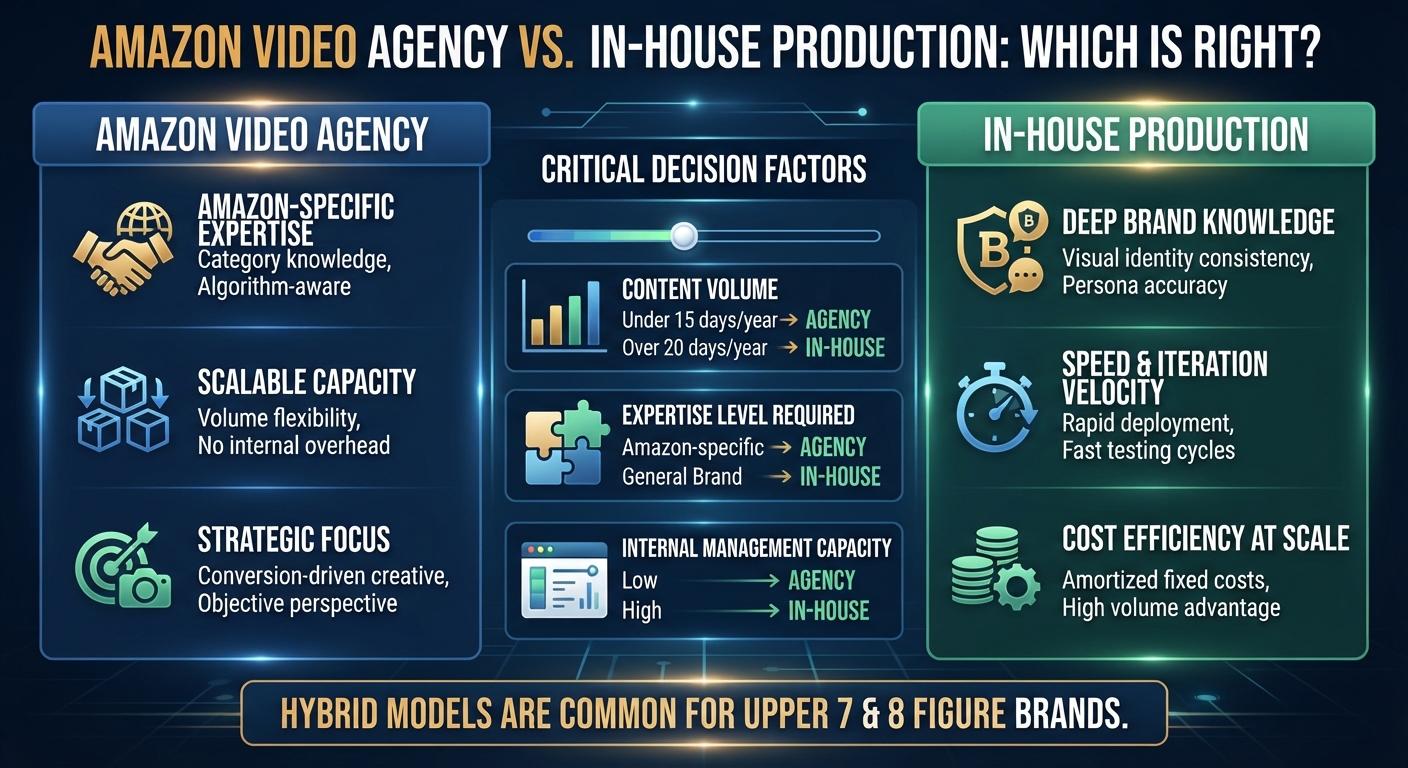
Brand knowledge depth. An in-house team builds deep, accumulated knowledge of the brand's visual language, buyer personas, and performance history across every piece of content produced. This knowledge depth is hard to replicate in an agency relationship, particularly with agencies that work across many different brands simultaneously.
Speed and iteration velocity. Internal teams can produce and deploy content faster than most agency workflows — eliminating the briefing, approval, production, and revision cycle that adds weeks to agency timelines. For brands running very high-frequency testing cycles, this speed advantage is significant.
Cost efficiency at scale. At sufficiently high production volume — typically 15 or more production days per year — in-house fixed costs (salaries, equipment, software) become more cost-efficient than agency variable costs for the same output.
The Honest Tradeoffs
The comparison between Amazon video agency and in-house production has several honest tradeoffs that neither side typically acknowledges clearly.
Agency tradeoff: context accumulation takes time. A new agency engagement starts with limited brand context. The first production cycle is often the weakest because the team is still building the brand knowledge that makes subsequent work better. Sellers who switch agencies frequently never get the benefit of accumulated context — they're perpetually in the weaker early-engagement phase.
In-house tradeoff: specialization is expensive. Amazon-specific video expertise — understanding the algorithm, knowing what converts in specific categories, maintaining awareness of Amazon policy changes that affect content — requires dedicated investment in specialization that generalist in-house teams rarely develop. The cost of this expertise gap shows up in video performance rather than in the production budget.
Hybrid model: Many sellers at the upper 7-figure level run a hybrid model — in-house capability for high-frequency, lower-stakes content (product photography, lifestyle variants, social content) and agency relationships for high-stakes production (new listing launches, Brand Story, and Sponsored Brand Video). This model captures the speed advantage of in-house for routine content and the expertise advantage of agency for strategic content.
The Questions That Determine the Right Answer
Rather than a universal recommendation, the right answer to agency vs. in-house depends on specific factors that vary by seller.
How many production days per year does your content strategy require? Under 8: agency almost certainly wins. 8 to 20: close evaluation needed. Over 20: in-house deserves serious consideration.
How important is Amazon-specific expertise to your content strategy? If your video strategy is primarily lifestyle and brand storytelling that doesn't require deep Amazon algorithm knowledge, in-house capability is more viable. If your strategy is conversion-focused, test-driven, and algorithm-aware, specialized agency expertise has compounding value that's hard to build internally.
How important is iteration speed? If your testing cadence requires deploying new creative variants weekly, internal speed advantage matters more. If your testing cadence is monthly, agency timelines are typically workable.
What is your team's honest capacity for managing creative production? Agency relationships require active management — briefing, review, feedback, direction — that takes meaningful time. Sellers who underestimate the management overhead of agency relationships often feel they're not getting the value they're paying for when the real issue is insufficient management investment.
Why We're Telling You Both Sides
At MyBrand Videos, we recognize that for some sellers at some stages, in-house production genuinely makes more sense than agency engagement. We'd rather tell you that clearly than earn an engagement that isn't the right fit.
The sellers we serve well are those for whom agency partnership creates more value than it costs: typically 6 to 8 figure Amazon brands with complex creative needs, Amazon-specific strategy requirements, and content volume that doesn't justify full in-house infrastructure.
If that description fits your situation, the free listing audit is where it starts.
Related articles:
