Amazon Video Content Strategy for 7-Figure Sellers
Amazon video content strategy at the 7-figure level looks fundamentally different from what works for sellers earlier in their growth. A single hero video that performed well at $500K in annual revenue simply doesn't carry the same weight once a brand reaches multiple ASINs, higher ad spend, and more sophisticated competitors fighting for the same shelf space.
This article breaks down how 7-figure sellers should structure their video content strategy — not as a series of one-off projects, but as a system that compounds over time.
Why Amazon Video Content Strategy Changes at Scale
At lower revenue levels, a single well-produced video can meaningfully move the needle because the baseline is often zero or close to it. Adding any professional video to an unoptimized listing typically produces dramatic improvement.
At the 7-figure level, this dynamic shifts considerably. Most listings already have some video. Competitors are sophisticated. Incremental gains require incremental sophistication — testing, persona targeting, and systematic refinement rather than a single creative win.
This is precisely why Amazon video content strategy for established sellers needs to function as an ongoing system rather than a project with a defined endpoint. The brands pulling ahead at this revenue level aren't relying on one strong video. They're running continuous creative cycles that compound advantage over months and years.
The Shift From Project Thinking to System Thinking
The mental shift required here is significant. Project thinking asks "what video do we need right now?" System thinking asks "what creative pipeline do we need to consistently outperform our category over the next 12 months?" The second question produces fundamentally different decisions about budget allocation, testing cadence, and team structure.
The Four Pillars of 7-Figure Amazon Video Content Strategy
A mature video content strategy at this revenue level typically rests on four interconnected pillars.
Pillar one: continuous competitive intelligence. Rather than auditing competitors once before a launch, 7-figure sellers run competitive video analysis on a rolling 90-day cycle across their top ASINs. This ensures creative decisions reflect what's currently working in the category, not what was working six months ago.
Pillar two: structured A/B testing. Single videos give way to tested variants — different hooks, different buyer personas, different objection-handling approaches — measured against real performance data rather than internal preference. This testing infrastructure becomes a permanent part of the creative process rather than an occasional initiative.
Pillar three: persona-specific creative. As catalogs grow and traffic diversifies, generic creative increasingly underperforms compared to content built for specific buyer segments. Sellers at this level typically maintain multiple creative variants per ASIN, each targeting a distinct buyer persona identified through review analysis and PPC data.
Pillar four: multi-channel consistency. Video content strategy at scale extends beyond Amazon itself. The same brand identity, tested messaging, and visual language that performs on Amazon typically gets adapted for DTC, social advertising, and wholesale materials — multiplying the return on each piece of strategic creative work.
Building the Monthly Creative Cycle
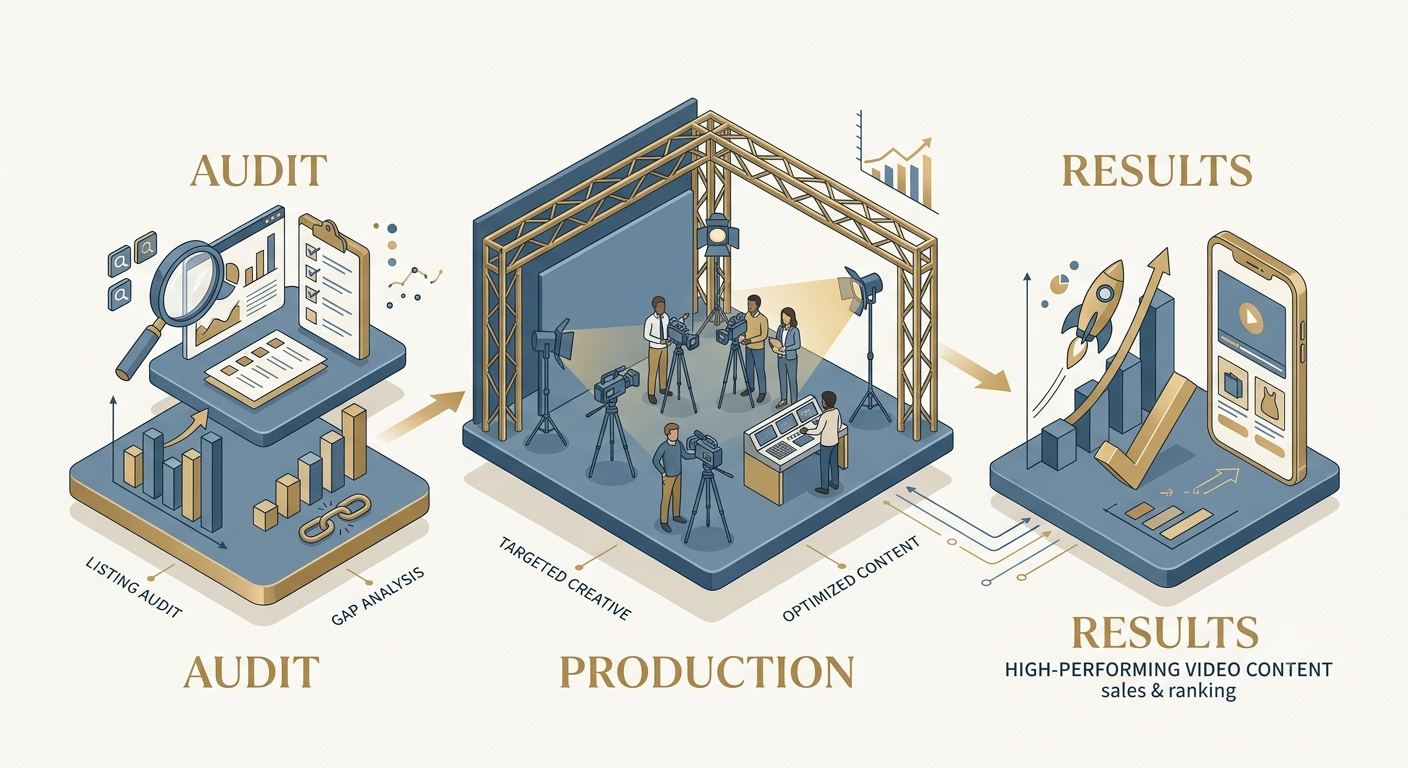
The operational backbone of effective Amazon video content strategy at the 7-figure level is a recurring monthly cycle rather than sporadic production sprints.
Week One: Data Review and Priority Setting
The cycle begins with reviewing the previous month's performance data — which creative variants outperformed, which keywords moved in rank, where conversion gaps remain. This data directly informs what gets produced in the coming cycle, ensuring creative decisions are evidence-based rather than based on internal assumptions about what might work.
Week Two: Production
With priorities set, production happens against a clear brief informed by the data review. This is where the creative team — whether internal or an outsourced production partner — executes against specific, documented objectives rather than open-ended creative direction.
Week Three: Deployment and Testing Setup
New creative deploys into the listing and PPC campaigns with structured A/B testing in place. Rather than simply replacing old content with new, the strongest approach runs new and existing creative simultaneously to generate clean comparative data.
Week Four: Monitoring and Documentation
The final week of each cycle focuses on monitoring early performance signals and documenting learnings, even before the test reaches full statistical significance. This documentation becomes the foundation for the next month's data review, creating a continuously improving knowledge base about what works for that specific brand and audience.
Allocating Budget Across an Amazon Video Content Strategy
One of the most common mistakes at this revenue level is concentrating the entire video budget into a single annual or quarterly production rather than distributing it across an ongoing cycle.
A seller spending $36,000 annually on video production sees meaningfully different results depending on allocation. Spent as one large production, that budget might produce a handful of polished assets used for an entire year without iteration. Spent as $3,000 monthly across a continuous testing cycle, the same budget produces a constant stream of tested variants, competitive responses, and persona-specific content that compounds in effectiveness over time.
The second approach consistently outperforms the first for sellers with sufficient traffic volume to generate meaningful testing data, because it treats creative as a living system rather than a static asset.
Multi-ASIN Strategy: Prioritizing Where Video Investment Goes
7-figure sellers typically manage multiple ASINs simultaneously, which raises a question that doesn't exist for single-product brands: where does video investment go first?
The most effective prioritization framework weighs three factors together. Revenue contribution identifies which ASINs generate the most total revenue and therefore offer the largest absolute return on conversion improvement. Competitive gap identifies which ASINs face the toughest competition relative to their current creative quality, representing the largest opportunity for improvement. Growth trajectory identifies which ASINs are positioned for scaling and where video investment compounds fastest as volume increases.
ASINs scoring highly across multiple factors receive priority in the monthly creative cycle, while lower-priority products receive lighter-touch updates on a longer cycle.
Why In-House Production Often Underperforms Outsourced Systems at This Stage
Many 7-figure sellers initially attempt to build internal video production capability, reasoning that ongoing need justifies a full-time hire. In practice, this often underperforms working with an established production partner for a specific reason: the volume of work for one or even several ASINs rarely justifies the full overhead of an in-house creative department, including equipment, specialized software, and diverse skill sets across scripting, filming, and editing.
A production partner running this same system across multiple client brands develops pattern recognition and efficiency that's difficult to replicate internally — and typically delivers a more consistent, sophisticated output at a comparable or lower total cost than building equivalent in-house capability.
Ready to Build a 7-Figure Amazon Video Content Strategy?
At My Brand Videos, our monthly subscription model is built specifically around this system-level approach — continuous competitive intelligence, structured A/B testing, persona-specific creative, and a recurring production cycle designed to compound results over time.
If you're still operating on a project-by-project video approach despite operating at 7-figure revenue, the system-level shift is likely your next highest-leverage move.
We'll review your current creative approach and show you what a structured monthly system would look like for your specific catalog and revenue level.
Related articles:
