Amazon Baby Product Video: What Actually Drives Conversion
Amazon baby product video operates in the category where purchase stakes feel highest to buyers. Parents purchasing products for infants and toddlers carry a level of responsibility-driven scrutiny that doesn't exist in most other Amazon categories — and video content that doesn't signal safety, credibility, and genuine understanding of a parent's concerns will consistently underperform against content that does.
This guide covers what specifically drives conversion in Amazon baby product video: the safety and trust signals that matter most, the emotional structure that connects with parent buyers, and the lifestyle execution decisions that communicate authenticity rather than aspiration.
The Parent Buyer's Decision Framework
Before addressing video strategy, understanding how parent buyers evaluate baby products reveals what video content needs to accomplish.
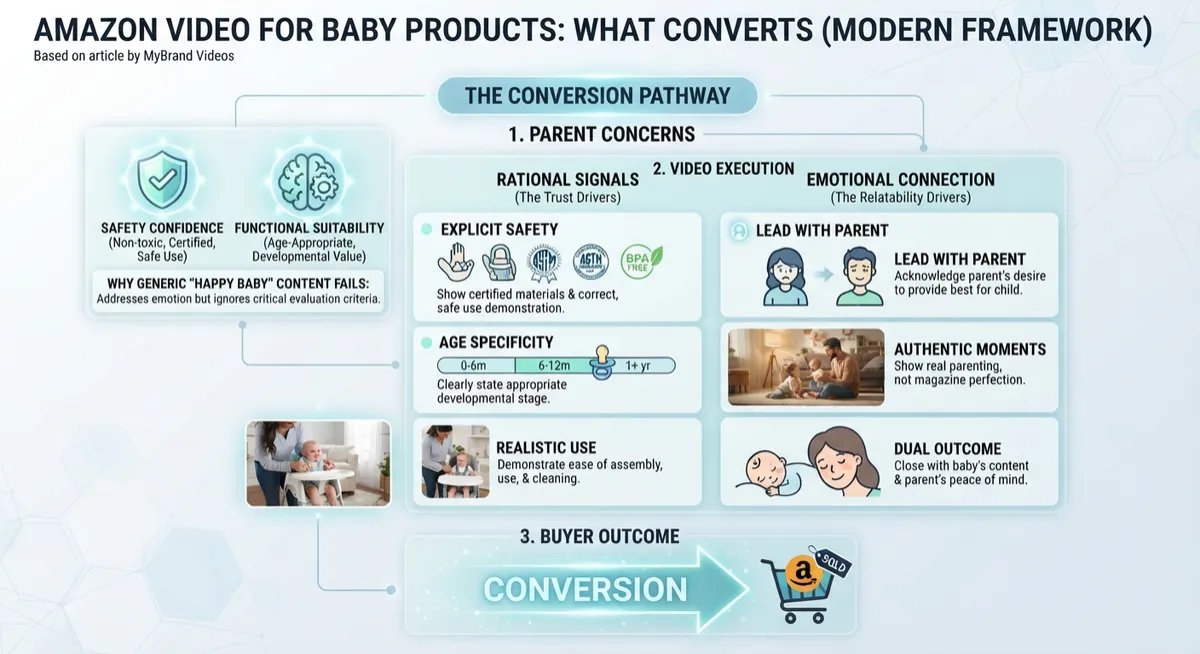
Parent buyers in the baby category evaluate purchases along two parallel dimensions simultaneously. The first is functional suitability — does this product do what it's supposed to do, correctly, for a baby at my child's specific age and development stage? The second, and often more powerful, dimension is safety confidence — is this product safe for my child, made by a brand I can trust, and free from materials or design elements that could cause harm?
Both dimensions must be addressed for conversion to occur, but safety confidence is the dimension most frequently underaddressed in baby product video — because brands often assume that featuring a happy baby using the product communicates safety implicitly. It doesn't. Implicit safety communication is not enough for a buyer who is evaluating whether to put this product in proximity to their infant.
Why Generic "Happy Baby" Content Underperforms
The generic baby product video format — a beautiful baby smiling while interacting with the product, in a pristine nursery, with soft music — communicates warmth but rarely addresses the specific safety and quality concerns that drive baby purchase decisions.
Buyers who are on their first child are highly research-driven and respond to specific, explicit safety communication. Buyers who are on their second or third child are more experienced but more discerning — they've been disappointed before, and generic warmth doesn't override their specific evaluative criteria. Neither buyer segment is primarily persuaded by emotional aesthetics alone.
Safety Signaling in Amazon Baby Product Video
The most important single element in baby product video is explicit, visible safety signaling — communicated through specific content choices rather than through claims.
Material and certification visibility. For any baby product where material safety matters — which is most of them — video that specifically shows or mentions certifications (JPMA, ASTM, CPSC compliance, BPA-free, non-toxic materials) and explains what they mean addresses the safety concern that underlies almost every baby purchase hesitation. Text overlays are not sufficient for this — a certification mentioned in text is less persuasive than one explained briefly in video narration or by a person on camera.
Age-appropriateness specificity. Baby buyers are acutely aware that developmental stage matters for product safety and utility. Video that specifically states the appropriate age range and explains why — why this product is appropriate from 0-6 months but not before, what developmental milestone it supports — communicates the brand's genuine understanding of infant development that generic "for your baby" language doesn't.
Real-use safety demonstration. For products involving any physical interaction with a baby — bouncers, carriers, sleep products, feeding tools — showing a real caregiver using the product correctly with a real infant is more reassuring than any claim. The key word is "correctly" — the demonstration should model safe use explicitly, because parents are watching specifically to understand whether they'll be able to use this product safely.
The Emotional Structure of Converting Baby Product Video
Baby product video that converts doesn't just address rational safety concerns — it also connects with the emotional dimension of parenting that underlies every purchase decision in this category.
Lead with the parent, not the baby. The most effective baby product video openings acknowledge the parent's experience — their desire to provide the best for their child, their awareness of how much is uncertain in early parenthood, their specific concern that this product will be the right choice — before introducing the product as the answer to that experience.
Show realistic parenting moments, not magazine parenting. Video featuring a perfectly calm baby in an immaculate nursery with a parent who is fully composed and elegantly dressed creates distance rather than identification for most actual parents. Video that shows slightly messier reality — a parent managing the product with one hand while holding the baby with the other, a nursery that has normal signs of habitation — creates identification that converts.
Close on the outcome for both parent and baby. The closing frames of baby product video should show both the baby's positive experience and the parent's peace of mind — because both matter to the buyer. A baby who is content and a parent who is visibly relaxed communicates the dual outcome that baby products are supposed to deliver.
Specific Video Elements for Baby Product Subcategories
Different baby product subcategories require different emphasis in video content.
Sleep products. Safety is the overwhelming priority — safe sleep guidelines are well-known and actively followed by informed parents. Video that explicitly aligns with AAP safe sleep recommendations and demonstrates correct safe-use positioning converts significantly better than video that shows adorable sleeping babies without safety context.
Feeding products. For feeding tools — bottles, spoons, high chairs — video demonstrating ease of assembly, ease of use for a parent feeding a baby with limited cooperation, and ease of cleaning addresses the three concerns that drive most feeding product returns and hesitations.
Carriers and wearables. The correct-use concern is particularly high for carriers and wearables. Video that shows the complete process of putting the carrier on correctly, positioning the baby safely, and checking for proper fit converts better than video that simply shows a parent wearing a baby. The process is the reassurance.
Developmental toys and enrichment. Video that explains the developmental benefit — specifically, what skill or milestone this product supports and at what age — positions the purchase as an investment in the child's development rather than simply a purchase of an object. This framing consistently elevates perceived value.
Lifestyle Execution for Baby Product Video
The lifestyle choices in baby product video significantly affect authenticity and conversion.
Real children over model children. Babies who are clearly comfortable and natural rather than directed and posed communicate genuine product acceptance in a way that model babies trained for commercial work don't. The slightly unpredictable behavior of a real baby is an authenticity signal that experienced parent buyers recognize.
Age accuracy. Using a baby who is visibly older than the stated target age range — which is common because older babies are more cooperative on set — creates a subtle credibility problem with discerning parent buyers who know what a 3-month-old looks like versus a 6-month-old.
Diverse representation. Baby category buyers include parents across every demographic, and lifestyle imagery that reflects only a narrow slice of parenthood creates implicit exclusion that reduces identification for buyers outside that slice. Intentional diversity in lifestyle casting broadens the identification response rather than narrowing it.
Ready to Build Baby Product Video That Converts?
At MyBrand Videos, baby category video is one of our most carefully approached specializations — including our multi-year partnership with a glow-in-the-dark baby blanket brand in Los Angeles that involved six distinct design variations, each requiring different children, different locations, and different narrative approaches.
Related articles:
