Amazon Lifestyle Photography and Video: What Converts
Amazon lifestyle photography and video are the listing elements that do the work no other format can: they place the product in the buyer's world rather than in a studio, and they help buyers answer the question "does this belong in my life?" in a way that product-only imagery never fully addresses.
However, lifestyle content that converts does so for specific, identifiable reasons — and lifestyle content that doesn't convert fails for equally specific reasons. The difference isn't production quality or aspirational appeal. It's whether the lifestyle content speaks to the buyer's actual situation rather than an idealized version the brand finds appealing.
This guide covers what makes Amazon lifestyle photography and video convert, how to brief them correctly, and what distinguishes lifestyle content that moves CVR from lifestyle content that simply looks beautiful.
What Lifestyle Content Is Actually Trying to Do
Before addressing strategy and execution, it's worth being specific about what Amazon lifestyle photography and video are designed to accomplish for the buyer — because the answer determines everything about how they should be briefed and produced.
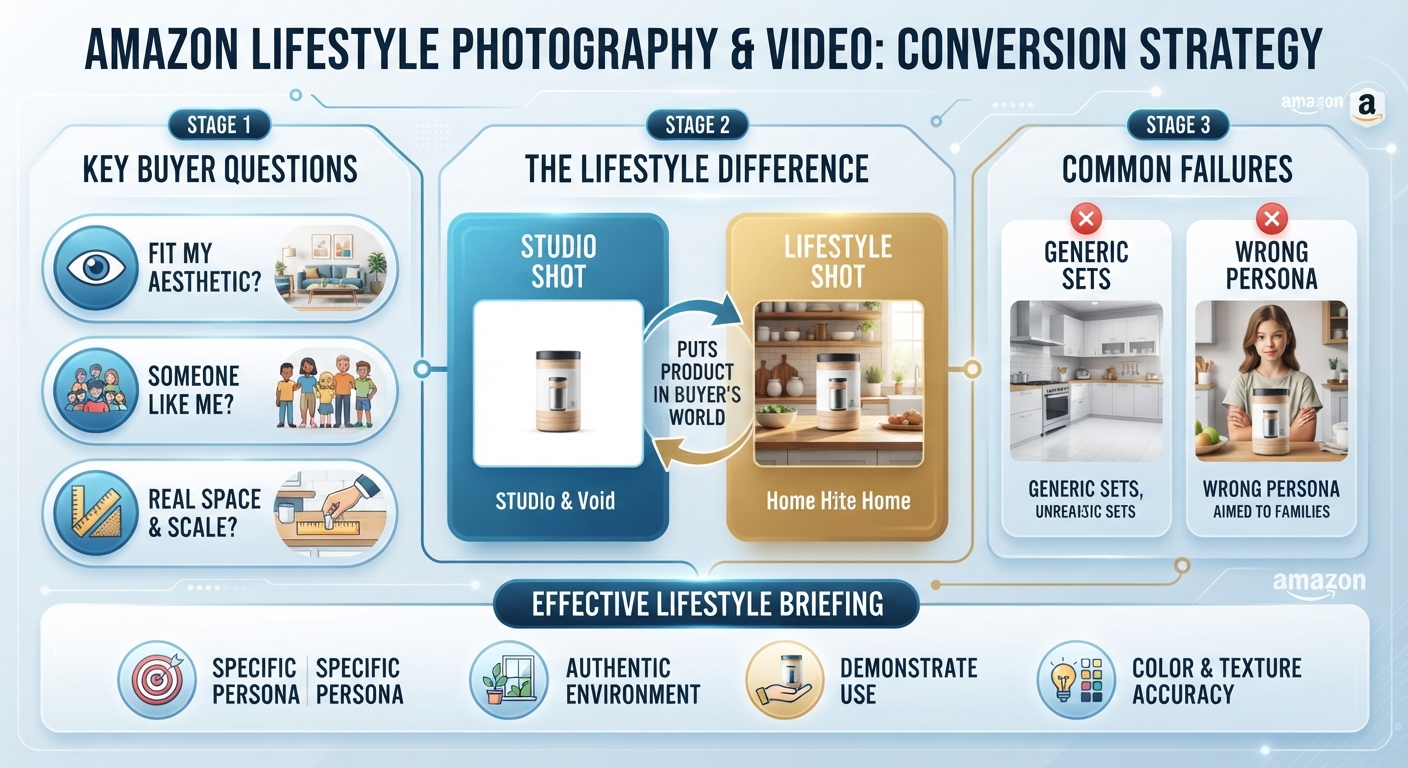
Lifestyle content exists to answer three buyer questions that studio product photography cannot.
Does this fit my aesthetic? Studio photography shows the product. Lifestyle photography shows the product in a space or context that communicates a visual aesthetic — and buyers evaluating home goods, apparel, accessories, and similar categories use lifestyle imagery to judge whether the product's visual identity is compatible with theirs.
Does someone like me use this? The people shown in lifestyle content are surrogates for the buyer. When buyers see someone who looks like them — similar age, lifestyle, relationship to the product — using the product naturally, the identification response is automatic and powerful. When they see someone who doesn't look like them or a context they don't recognize as their own, the content generates distance rather than identification.
What does it actually look like in a real space? Scale, color accuracy under real lighting, and texture in a real environment are all communicated better through lifestyle imagery than through studio photography — which is why lifestyle content is particularly high-impact for categories where these attributes drive both purchase decisions and return rates.
The Most Common Lifestyle Content Failures
Understanding what makes Amazon lifestyle photography and video fail is as useful as understanding what makes them succeed.
Generic lifestyle sets. A kitchen product photographed in a pristine, perfectly staged kitchen that no actual buyer's kitchen resembles generates distance rather than identification. Buyers look at it and think "that's beautiful" rather than "that's my counter." The aspirational set works for luxury brands selling aspiration. For most Amazon categories, a slightly realistic lifestyle context converts better than a magazine-perfect one.
Wrong buyer persona in the imagery. A pet product that photographs young professional owners when its actual buyers are families with children is building lifestyle content for an audience that isn't purchasing. Review analysis and customer data should drive the persona decision — not the brand's preferred self-image.
Lifestyle content that repeats studio content. Lifestyle video that shows the product in a context but doesn't demonstrate it in use provides little additional conversion value over studio photography. The specific advantage of lifestyle video is showing the product functioning naturally in a real context — with the buyer's physical experience implied. Static-looking lifestyle video wastes the format.
Over-styling that erases credibility. Props, styling, and set decoration that draw attention to themselves — rather than making the product look natural in a real environment — reduce the authenticity signal that lifestyle content is supposed to generate.
Briefing Amazon Lifestyle Photography and Video
The brief for lifestyle content determines whether it converts. The elements of a brief that matter most:
Buyer persona specificity. Define the person in the lifestyle content precisely: age range, gender, lifestyle context, relationship to the product, household composition if relevant. "Young professional woman" is not specific enough. "35-year-old woman who cooks at home 4 nights per week and values organization in a small kitchen" is specific enough to make concrete casting and styling decisions.
Environment authenticity level. Define explicitly how realistic the environment should look. For most Amazon categories, slightly imperfect is more converting than perfectly staged. Specifying that the kitchen counter should have normal objects visible, that the lighting should be natural rather than studio-optimized, and that the model's interaction with the product should look practiced rather than posed gives production specific direction toward authenticity.
Content that needs to be demonstrated, not just shown. Lifestyle video specifically should demonstrate the product in use rather than simply showing it in a context. Define in the brief what the product is doing in the lifestyle footage — not just where it is.
Color and texture accuracy requirements. If color accuracy is a purchase driver or return driver for your product, the brief should specify that lifestyle imagery be shot under multiple realistic lighting conditions rather than optimized studio lighting.
Amazon Lifestyle Photography and Video Across the Buying Journey
Different lifestyle content serves different purposes depending on where it appears in the listing.
Gallery lifestyle images are the buyer's first encounter with lifestyle content — typically seen before any video plays. These images need to establish the persona match and aesthetic compatibility quickly. First gallery lifestyle image priority: showing the product in the most immediately recognizable real context for the target buyer.
Listing video lifestyle segments have more time to develop context and demonstrate product use naturally. The lifestyle segment of a listing video typically works best in the first 15 to 30 seconds — establishing the context before the product is introduced — and in the final 15 seconds — showing the outcome of product use in the lifestyle setting.
A+ Content lifestyle modules reach buyers at higher engagement and can sustain slightly more complexity and context. Multiple lifestyle scenarios demonstrating different use cases or buyer contexts work well in A+ Content because buyers who reach it have signaled a higher willingness to engage with additional information.
Ready to Build Lifestyle Content That Actually Converts?
At MyBrand Videos, lifestyle production is briefed from review analysis and buyer data rather than from internal brand aesthetics. We cast based on who actually buys the product, style based on what makes the product look real rather than aspirational, and produce lifestyle video that demonstrates rather than decorates.
Related articles:
