Amazon Video Testimonials: Best Practices That Convert
Amazon Video Testimonials: Best Practices That Convert
Amazon video testimonials are one of the most underused trust signals on the entire platform — and one of the highest-leverage additions you can make to a listing that already has solid traffic but an underperforming conversion rate.
This guide covers what makes Amazon video testimonials actually convert, where to place them for maximum impact, and how to source and script them so they feel authentic rather than staged.
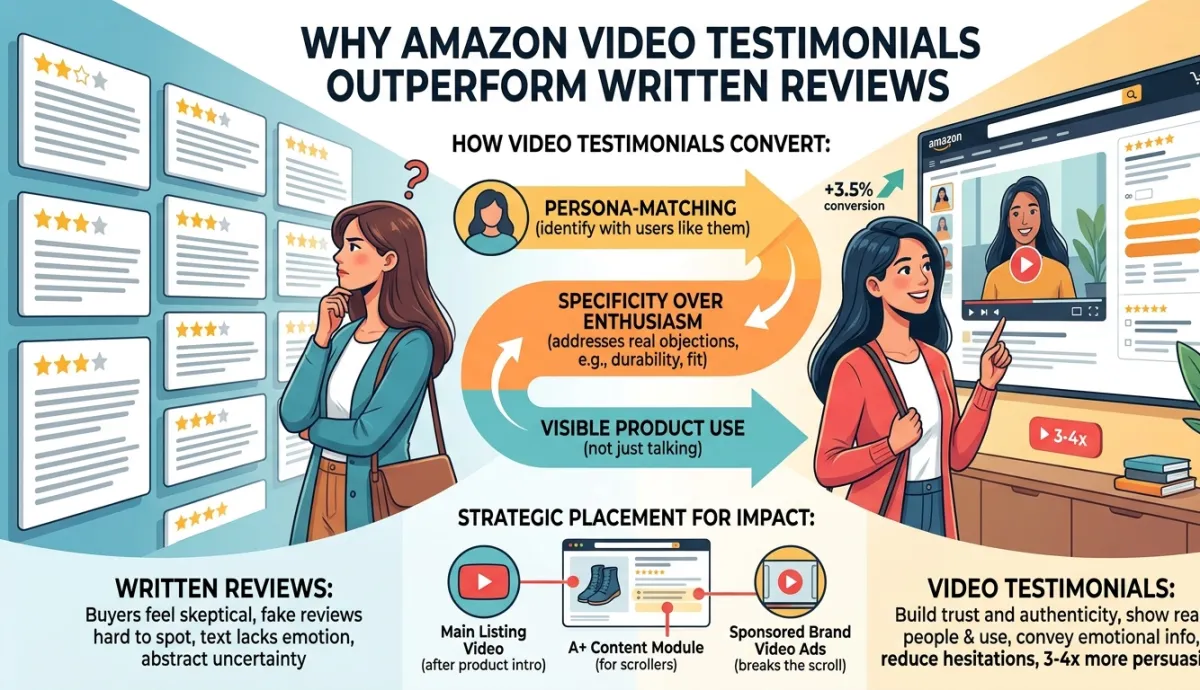
Why Amazon Video Testimonials Outperform Written Reviews
Written reviews carry weight on Amazon, but buyers have learned to read them skeptically. Fake reviews, incentivized reviews, and review manipulation scandals have made shoppers more cautious than they were five years ago. A video, however, is much harder to fake convincingly — and buyers intuitively understand that.
When a real person speaks on camera about their experience with a product, several things happen simultaneously. Their tone of voice carries emotional information that text cannot. Their facial expressions provide a second layer of authenticity signal. Furthermore, the simple act of seeing another human use the product reduces the abstract uncertainty that drives so many Amazon purchase hesitations.
This is precisely why Amazon video testimonials consistently outperform star ratings and written reviews as a trust signal, even when the written reviews are genuinely positive. The format itself does work that text cannot replicate.
The Specific Psychology at Play
Buyers don't just want to know that a product works. They want to see someone like them using it successfully. A testimonial from a buyer who matches the target persona — similar age, lifestyle, or use case — creates an identification response that no amount of marketing copy can produce. This is the core reason persona-matched testimonials outperform generic ones, regardless of production quality.
Where to Place Amazon Video Testimonials for Maximum Impact
Placement matters as much as content quality. A strong testimonial in the wrong position underperforms a mediocre one placed correctly.
Within your main listing video. The second half of your primary product video is the optimal placement for testimonial content. By that point, the buyer already understands what the product does and how it works — which means they're ready to be influenced by someone else's experience rather than still trying to understand the basics.
In your A+ Content module. A dedicated testimonial video module within A+ Content gives buyers who scroll past the main video a second opportunity to encounter social proof. This is particularly effective for considered purchases above $50, where buyers typically engage with more of the listing before deciding.
In Sponsored Brand Video ads. Testimonial-led PPC video consistently shows stronger engagement metrics than product-only video, because it interrupts the scroll with something that feels more like organic content and less like an advertisement.
The mistake we see most often is sellers placing testimonial content at the very beginning of their video. Buyers haven't yet built enough context about the product to find a stranger's opinion meaningful. Save it for after the product has been introduced.
What Makes an Amazon Video Testimonial Actually Convert
Not every testimonial drives conversion. The difference between one that works and one that gets skipped comes down to a handful of specific elements.
Specificity over enthusiasm. A testimonial that says "I love this product, it's amazing" provides almost no useful information to a skeptical buyer. A testimonial that says "I was worried this wouldn't fit my small kitchen counter, but it's actually compact enough that I keep it out all the time" addresses a real objection and demonstrates genuine use. Specificity is, therefore, the single most important quality to look for when sourcing testimonial content.
Addressing a real objection. The strongest testimonials directly counter a hesitation that shows up in your negative reviews or customer service inquiries. If buyers frequently ask whether a product is durable enough for daily use, a testimonial from someone who has used it daily for six months is worth more than five generic positive comments.
Visible product use, not just talking. A testimonial where the person is actually using the product while speaking performs better than one where they're simply facing the camera. The combination of demonstration and endorsement is more persuasive than either element alone.
Natural, unscripted language. Buyers can sense when a testimonial sounds rehearsed or corporate. The best approach is providing a creator with talking points rather than a script, and allowing them to express the message in their own words. This is, consequently, why working with a vetted UGC creator network tends to outperform scripted brand-produced testimonials.
Sourcing Amazon Video Testimonials: Three Approaches
There are three primary ways to source testimonial content, each with different tradeoffs.
Real Customer Outreach
Reaching out to verified purchasers who left positive written reviews and asking if they'd be willing to record a short video testimonial is the most authentic approach. The challenge is response rate — most customers won't respond, and incentivizing them with a discount or gift card requires careful compliance with Amazon's policies around reviews and testimonials.
Vetted UGC Creator Networks
Working with creators who specialize in authentic-feeling product content offers more reliability and faster turnaround than customer outreach. The creator isn't necessarily a real purchaser, but a skilled UGC creator can still produce content that feels genuine because they understand pacing, tone, and the specific kind of imperfection that signals authenticity to viewers.
Hybrid: Real Customers, Professional Direction
The strongest approach combines real customers with light professional direction — providing talking points, basic filming guidance, and editing support without scripting their exact words. This preserves authenticity while ensuring the final video meets a quality bar appropriate for a paid listing asset.
Common Mistakes That Undermine Amazon Video Testimonials
Several recurring mistakes reduce the effectiveness of testimonial content, even when the underlying sentiment is genuinely positive.
Over-editing for polish. Heavy color grading, dramatic music, and tightly cut editing can make a testimonial feel like a commercial rather than a genuine review. Buyers respond better to testimonials that retain some of the natural imperfection of real video.
Using testimonials that could apply to any product. If a testimonial would work equally well for a competing product in the same category, it's too generic to be useful. Every testimonial should reference something specific to your product.
Ignoring negative-review themes. If your product has a recurring complaint in its reviews, ignoring that topic in your testimonials is a missed opportunity. Addressing it directly, through a customer who experienced and overcame that exact concern, is far more persuasive than pretending the concern doesn't exist.
Failing to caption the video. Most Amazon video views happen with sound off, particularly on mobile. A testimonial without captions loses most of its persuasive power for the majority of viewers who never hear the words being spoken.
Measuring Whether Your Testimonials Are Working
Because testimonial content is just one component of a listing, isolating its specific impact requires structured testing rather than guesswork.
The most reliable approach is testing a version of your listing video with a testimonial segment against a version without one, using Amazon's Manage Your Experiments tool for surrounding listing elements while tracking video engagement separately through your analytics. If the testimonial version shows meaningfully higher conversion over a 4–6 week test period with sufficient traffic, that's your answer.
Additionally, watch your video completion rate. Testimonials placed in the second half of a video should correlate with sustained watch time through that segment. A significant drop-off right when the testimonial begins suggests the placement or content needs adjustment.
Ready to Add Testimonials That Actually Convert?
At My Brand Videos, we source, brief, and produce video testimonials as part of our full creative production process — mapped directly to the objections and personas that matter most for your specific product.
If your listing has solid traffic but conversion that hasn't matched expectations, testimonial content built around your real buyer objections is often the fastest lever to pull.
We'll review your current listing, your review themes, and show you exactly where testimonial content could move your conversion rate.
Related articles:
