Amazon Explainer Video: What Works on Listings in 2026
Amazon explainer video — video content specifically designed to help buyers understand how a product works, why it works that way, and what that means for their specific situation — is the most powerful format available for complex, technical, or unfamiliar products. However, it's also the format most commonly executed in a way that confuses rather than converts, because the educational impulse that drives explainer content frequently produces videos that teach rather than persuade.
This guide covers what makes Amazon explainer video effective on a listing specifically, how to distinguish between content that educates and content that converts, and how to structure explainer video for maximum persuasive impact.
When Amazon Explainer Video Is the Right Format
Not every product needs an explainer video, and applying the explainer format to a product that doesn't require it typically produces a video that's longer, more complex, and less converting than a straightforward product demonstration.
The conditions that make Amazon explainer video the right choice are specific. First, the product involves a mechanism, process, or technology that buyers don't understand intuitively — supplements with a proprietary formulation, smart home devices with non-obvious functionality, multi-function tools with setup requirements, or any product where "how does this actually work?" is a genuine buyer question rather than a rhetorical one.
Second, the product benefit is non-obvious from visual inspection alone. A product that looks like a simple gadget but delivers results through an underlying mechanism that explains why the price is justified needs explainer content to make the value proposition legible.
Third, competitor listings in the category are failing to explain the product's mechanism — leaving buyers who want to understand before purchasing without a reliable source. In these situations, the listing that explains most clearly often earns the purchase over listings with better imagery or lower prices.
The Core Tension in Amazon Explainer Video: Education vs. Persuasion
The fundamental challenge in Amazon explainer video is navigating the tension between the educational goal — help the buyer understand — and the persuasive goal — give the buyer a reason to buy now.
Most educational content prioritizes completeness. Most persuasive content prioritizes relevance. An explainer video that covers everything about how a product works is usually too long, too detailed, and too abstracted from the buyer's actual purchase decision to convert well. An explainer video that covers only what the buyer needs to understand in order to feel confident buying is typically 60 to 90 seconds and converts far more effectively.
The Filter That Resolves the Tension
The question that resolves this tension is: what does the buyer need to understand in order to stop hesitating and make the purchase? The answer is almost always narrower than the complete explanation of how the product works. Furthermore, it's almost always answerable visually rather than verbally, which is why the strongest Amazon explainer videos demonstrate the mechanism rather than narrating it.
Structuring an Amazon Explainer Video That Converts
High-converting Amazon explainer video follows a structure that keeps persuasion as the goal throughout, even when education is the mechanism.
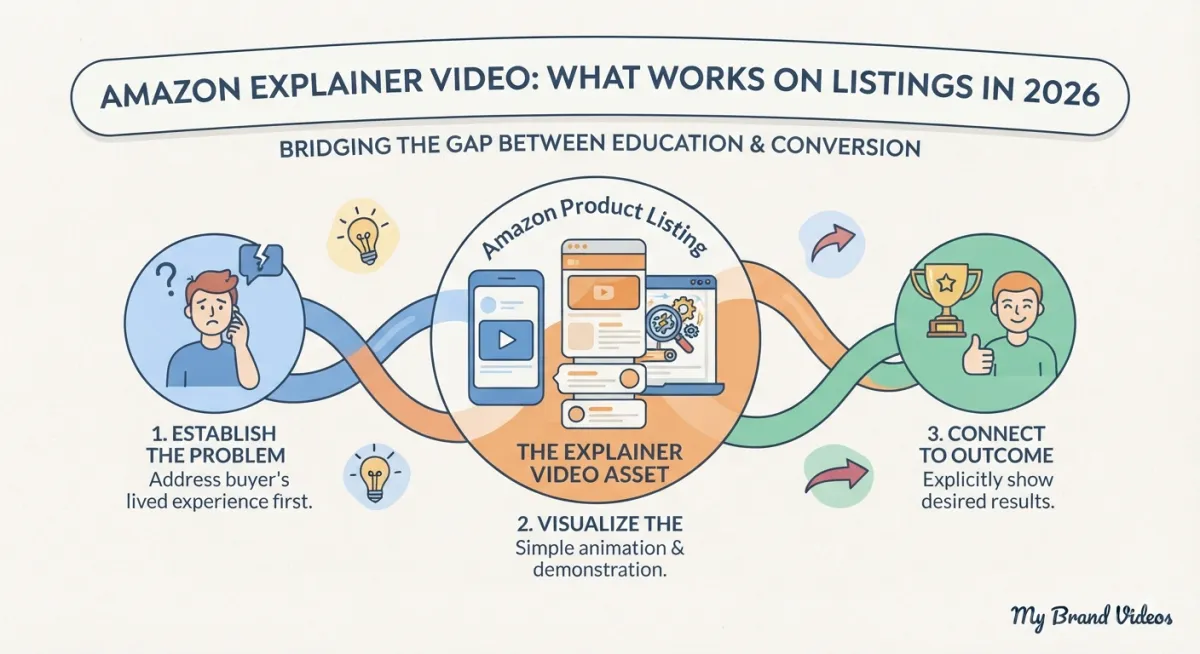
Open with the problem the mechanism solves, not the mechanism itself. "You've probably experienced this" is a stronger opening for an explainer video than "here's how this technology works" — because it connects with the buyer's lived experience before asking them to engage with an explanation.
Explain the mechanism in the simplest visual terms possible. The explanation should be as short as comprehension allows — not as thorough as completeness requires. Use animation, comparison, or visual demonstration in preference to verbal explanation wherever possible. Buyers process visual information faster and retain it longer than verbal explanation alone.
Connect the mechanism explicitly to the buyer's desired outcome. After explaining how the product works, make the connection to what the buyer cares about immediately explicit. "Because it works this way, you get this result" is the sentence structure that makes educational content persuasive.
Address the mechanism-related objection. For products with a novel or proprietary mechanism, there's typically a "but does it actually work?" skepticism that persists even after the explanation. Testimonial content or visible evidence of the mechanism working in a real-use context addresses this skepticism directly and is typically the highest-converting element of an Amazon explainer video.
Length and Format Considerations for Amazon Explainer Video
Amazon explainer video faces different length pressures than standard product demonstration video because the educational component genuinely requires time to be useful.
For most explainer contexts, 60 to 90 seconds is the appropriate target — long enough to explain the mechanism meaningfully, short enough to retain buyer attention through the full explanation. For highly technical products where buyers expect and want detailed technical explanation, 90 to 120 seconds can work within A+ Content video placement, where buyers engaging with the module have demonstrated higher-than-average intent.
Additionally, animated explainer segments within otherwise live-action video often perform better than fully animated explainers for Amazon specifically, because live-action product footage builds the tangible credibility that animation cannot — while the animated segment handles the mechanism explanation more efficiently than live demonstration of abstract processes.
Common Mistakes in Amazon Explainer Video
Several patterns consistently reduce the effectiveness of explainer video on Amazon listings.
Explaining the mechanism before establishing the problem. Buyers engage with explanations of solutions to problems they recognize. An explanation of a mechanism they don't yet have reason to care about — because the problem hasn't been established — generates low engagement regardless of how clear the explanation is.
Making the explanation more complex than buyer comprehension requires. Completeness in explanation serves the brand's desire to be thorough, not the buyer's need to understand enough to purchase. Every additional element of explanation that doesn't directly support the purchase decision reduces the video's persuasive efficiency.
Using technical language that matches the brand's internal vocabulary rather than the buyer's. Technical terminology that's standard within a product category often sounds jargon-heavy and alienating to buyers who are encountering the product for the first time. The simplest language that accurately represents the mechanism is almost always the most persuasive.
Ready to Build an Amazon Explainer Video That Converts?
At My Brand Videos, we've produced explainer video for supplement brands, smart home products, multi-function tools, and technical outdoor gear — always with the same constraint: the explanation must serve the purchase decision, not the brand's desire for completeness.
Related articles:
