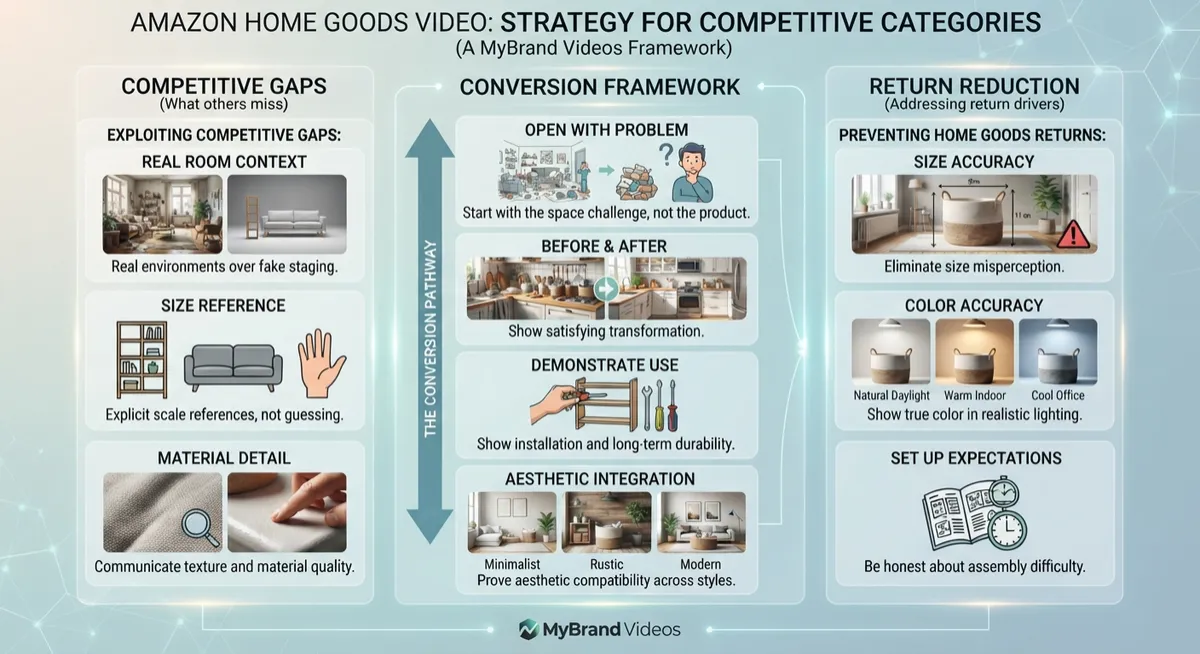
Amazon Home Goods Video: Strategy for Competitive Categories
Amazon home goods video faces a specific competitive challenge: the home category is one of the most crowded on the platform, with established retail brands, private label competitors, and direct-from-manufacturer imports all competing on the same visual landscape. Differentiation through video in this context requires understanding not just what makes good home goods video in general, but specifically what competing listings are failing to do — and building creative around those gaps.
This guide covers what drives conversion in Amazon home goods video, how to identify and exploit competitive gaps in the home category, and the specific video elements that consistently outperform in home, décor, organization, and storage subcategories.
The Home Goods Buyer's Decision Framework
Home goods buyers evaluate purchases along dimensions that reflect the dual nature of home products as both functional tools and aesthetic components of a living space.
Functional performance. Does this product do what it's supposed to do reliably? For organizational products, this means capacity, stability, and ease of use. For home tools, it means durability and effective function. For decorative items, it means quality of materials and construction that justifies the price.
Aesthetic compatibility. Does this product look right in my home? This dimension is unique to home goods among most Amazon categories — buyers aren't just purchasing function, they're purchasing something that will occupy visible space in their living environment. Video that shows the product in realistic home environments — not just in pristine studio settings — addresses this compatibility question more effectively than studio photography.
Size and scale accuracy. Home goods returns are frequently driven by size misperception — products that look proportionate in listing photography but arrive either larger or smaller than the buyer expected in their specific space. Video with explicit scale references, room-context demonstrations, and size comparisons is one of the most direct interventions available for this specific return driver.
What Home Goods Competitors Consistently Miss
Running a competitive video audit across most home goods subcategories reveals several consistent gaps that create opportunity for brands with differentiated creative.
Real room context over studio staging. The majority of home goods listing videos show products in studio environments styled to look like rooms — with professionally curated props, perfect lighting, and no signs of actual habitation. Most buyers' homes look nothing like this, and the disconnect reduces the identification response that drives purchase confidence. Video shot in genuinely lived-in environments — with normal room conditions, natural lighting variation, and realistic home contexts — consistently generates stronger identification than studio staging.
Size reference that works for home scale. Studio product photography creates size reference problems that are uniquely significant in home goods because buyers are evaluating how a product will fit in a specific space they have. Video that shows the product in a room context with clearly identifiable reference points — next to a standard sofa, against a typical wall, beside a common piece of furniture — eliminates the imagination work that drives size-related returns.
Material quality that photography can't communicate. Texture, weight, and material quality are central purchase drivers in home goods, particularly at higher price points. Video that specifically shows material detail — fabric texture under light, the sound of drawer runners, the weight of a ceramic piece — communicates quality dimensions that photography cannot.
Video Structure for Home Goods Conversion
Open with the room problem, not the product. Home goods buyers are almost universally solving a space problem — too little storage, a room that doesn't flow well, a surface that needs organization. Opening the video by acknowledging the specific space challenge the product addresses creates immediate relevance for buyers who have that problem.
Show the before-and-after transformation. Home goods are uniquely suited to before-and-after video structure because the transformation is visible and satisfying. A disorganized closet becoming organized, an empty wall gaining visual interest, a chaotic kitchen counter becoming functional — these transformations communicate the product's value proposition more powerfully than demonstration alone.
Demonstrate installation or setup for appropriate products. For home goods requiring installation or assembly — shelving, storage systems, wall-mounted items — showing the complete setup process addresses the ease-of-installation concern that prevents purchase among buyers who worry about DIY complexity. Furthermore, showing realistic installation difficulty (rather than an edited version that makes it appear effortless) sets accurate expectations and reduces returns from buyers who feel the process was misrepresented.
Show the product over time in use. For home goods where durability and longevity matter — furniture, organization systems, cookware — a brief segment showing the product after extended use, or testimony from a long-term user, addresses the durability concern that studio-fresh product imagery cannot.
Aesthetic Integration Video for Home Goods
One of the most underused video formats in the home goods category is aesthetic integration content — video that specifically shows how the product integrates into different existing home aesthetics.
A storage basket that works in a minimalist Scandinavian interior, a traditional farmhouse setting, and a modern urban apartment is a more versatile purchase than one shown only in one aesthetic context. Video that shows this versatility explicitly — with brief segments in different interior styles — expands the buyer population who can confidently purchase, because it removes the "but will this work in my home" hesitation for buyers whose aesthetic doesn't match the primary lifestyle context shown.
Return Reduction Video for Home Goods
The home goods category has an above-average return rate driven primarily by three factors that video can directly address.
Size misperception is the most common driver. For any home product where size relative to space is a purchase factor, video that shows the product in a realistic room with clearly identifiable scale references is the highest-return single addition to the listing.
Color and finish accuracy is the second most common driver. Home goods colors and finishes frequently photograph differently than they appear in real home lighting — and buyers returning products for "color not as shown" is a preventable conversion failure. Video shot under multiple real lighting conditions (natural daylight, warm incandescent, cool fluorescent) shows the product's true color range.
Assembly difficulty is the third driver for products requiring setup. Video that honestly shows assembly time and complexity — rather than editing to minimize it — sets expectations that reduce post-purchase frustration returns.
Ready to Build Home Goods Video That Converts?
At MyBrand Videos, home goods video is a core production specialization — including outdoor entertaining and home kitchen brands where scale, aesthetic integration, and before-and-after transformation are central to the creative approach.
Related articles:
