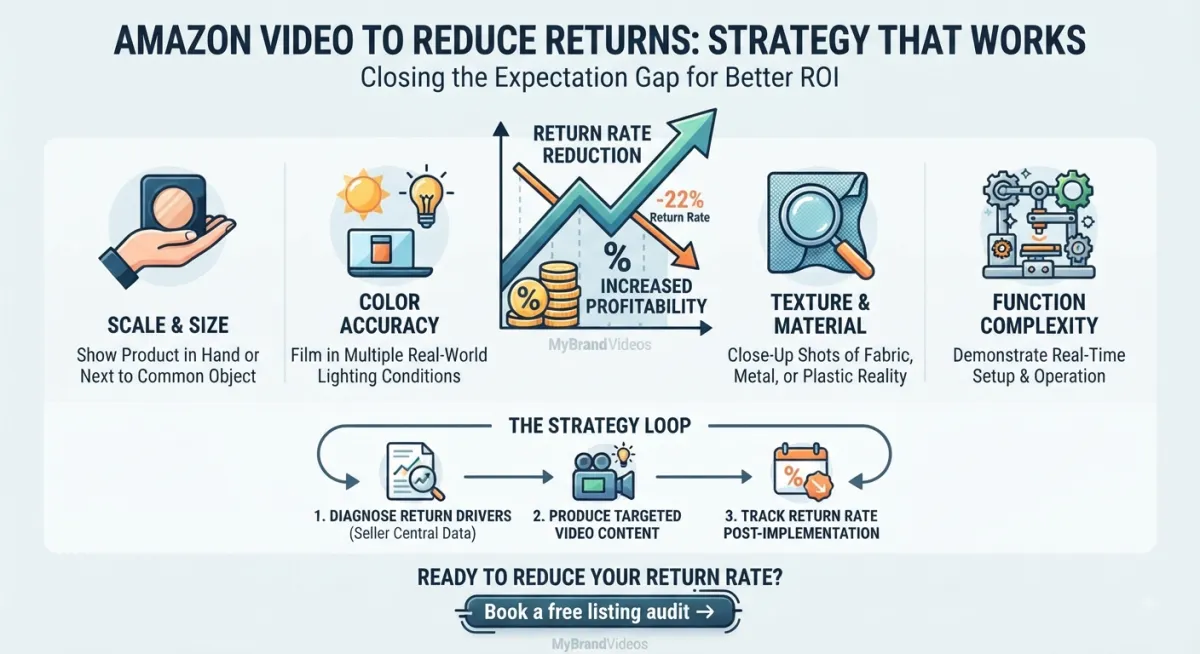
Amazon Video to Reduce Returns: Strategy That Works
Using Amazon video to reduce returns is one of the clearest ROI calculations in listing optimization — because the cost of each return is concrete, the mechanism is well understood, and the video elements that address return-driving concerns are identifiable before production begins.
This guide covers how to use video specifically to close the expectation gap that causes most Amazon returns, which video elements have the highest return-reduction impact, and how to measure whether your video strategy is working on this dimension.
Why Most Amazon Returns Are a Video Problem
Amazon return data, across categories, consistently shows that the majority of non-defective returns are driven by one root cause: the product the buyer received didn't match what they expected based on the listing. This expectation gap is almost never a function of the written description being inaccurate — it's a function of images and copy being insufficient to communicate the full reality of the product's scale, texture, weight, color, or function.
Video, specifically, is uniquely capable of closing this gap — because it communicates product reality through motion, scale reference, and demonstration in a way that photography and text fundamentally cannot replicate. Furthermore, the categories with the highest return rates on Amazon are precisely the categories where this physical reality is hardest to communicate through static images: home goods, apparel, kitchen tools, electronics, fitness equipment.
The Cost Calculation That Makes Video Investment Obvious
Before addressing strategy, it's worth establishing the financial context. For a seller moving 400 units per month at a $55 ASP with a 16 percent return rate, each 1 percentage point reduction in returns saves approximately $220 per month — $2,640 annually. A 5 percentage point reduction saves $13,200 annually. Against a professional video investment in the $2,000 to $4,000 range, that math justifies the investment on return rate reduction alone, before any CVR improvement is factored in.
The Four Expectation Gaps That Video Closes Best
Not all return-driving concerns are equally addressable through video. The four gaps that video closes most effectively are the following.
Scale and size expectation. "Smaller than expected" is the most common return reason across physical product categories on Amazon. Photography, even with dimension callouts, struggles to communicate scale in a way that feels real to buyers. Video that shows a human hand holding the product, a common household object placed next to it, or explicit in-frame measurement references makes size immediately comprehensible in a way that text and photography cannot.
Color accuracy expectation. Studio photography under controlled lighting frequently presents colors that look different from the product under real-world lighting conditions. Video shot under a variety of realistic lighting conditions — indoor, outdoor, natural, artificial — shows buyers what the product actually looks like in their environment rather than in an optimized studio setup. This is particularly high-impact for home goods, apparel, and beauty categories where color is a primary purchase driver.
Texture and material quality expectation. The tactile qualities of a product — how fabric feels, how metal sounds, how plastic flexes — are impossible to communicate through images but can be approximated through careful video technique. Close-up texture shots, sounds of materials, and demonstrations of flexibility or rigidity give buyers sensory information that images withhold entirely.
Function complexity expectation. Products that require assembly, setup, or non-obvious use technique generate returns when buyers find the reality of operation more complex than the listing suggested. Video that demonstrates setup and operation in real time — without shortcuts or editing that makes it appear simpler — sets accurate functional expectations that reduce post-purchase frustration and the "too complicated" return.
Building a Return-Reduction Video Strategy
Using Amazon video to reduce returns requires identifying which expectation gap is driving your specific return volume before any production decisions are made.
Step One: Diagnose Your Return Drivers
Pull your return reason data from Seller Central — specifically the reason codes provided by buyers. Categorize the reasons into the four gap types above. The category with the highest return volume becomes the first production priority.
Additionally, review your negative reviews for return-adjacent language: "smaller than expected," "color looks different in person," "harder to assemble than shown," "material feels cheaper than it looks." This language identifies your return drivers even when formal return reason codes are vague.
Step Two: Build the Video Specifically Around the Gap
Once you've identified the primary expectation gap, the video brief becomes specific. A size expectation gap brief specifies: show the product held in an adult hand, placed next to a common household item for reference, and display explicit dimensions in frame. A color expectation gap brief specifies: film under 3 to 4 lighting conditions including natural daylight, indoor warm lighting, and indoor cool lighting.
This specificity in the brief is what separates a return-reduction video from a generic product video. The generic version shows the product looking good. The return-reduction version shows the product as the buyer will actually experience it.
Step Three: Track Return Rate Before and After
Set a clean 30-day baseline return rate before the video goes live. Then track monthly for 90 days post-implementation. Return rate improvement is typically faster to appear than organic rank improvement — often visible within 60 days for categories where expectation mismatch is the primary driver.
Which Video Placements Have the Most Return-Reduction Impact
Different video placements contribute to return reduction differently.
Main listing video has the broadest reach and, therefore, the largest absolute return-reduction potential. The majority of buyers who convert through the listing will have encountered the main video — which means expectation-setting content in this placement reaches the largest possible audience.
A+ Content video reaches buyers at higher purchase intent who engage more deeply with the listing. For categories where complex assembly or function is the return driver, a more detailed demonstration in A+ Content — longer and more thorough than the main listing video — can address the complexity concern for buyers who specifically sought out more information before purchasing.
Product demo segments embedded within either placement that specifically address return-driving concerns have the clearest measurable impact on the specific return category they target.
Ready to Use Video to Measurably Reduce Your Return Rate?
At MyBrand Videos, return rate reduction is one of the three core metrics we build every video strategy around — alongside CVR improvement and organic rank impact. Every production brief begins with a return reason diagnosis to ensure the video is addressing the gaps that actually drive return volume for that specific product.
Related articles:
