Amazon Kitchen Video: What Converts in the Toughest Category
Amazon kitchen video operates in one of the most competitive and most visually crowded categories on the platform. The kitchen category has more established brands, more private label competition, and more sophisticated buyer expectations than almost any other Amazon category — which means the bar for video that actually differentiates a listing and moves conversion is higher here than in most other contexts.
This guide covers what specifically drives conversion in Amazon kitchen video: the buyer questions that kitchen products generate, the video elements that answer them most effectively, and the specific competitive patterns in the category that create opportunity for brands with differentiated creative.
What Kitchen Category Buyers Are Actually Evaluating
Kitchen product buyers have a specific set of purchase concerns that are different from buyers in most other categories — and understanding them is the starting point for any Amazon kitchen video that converts.
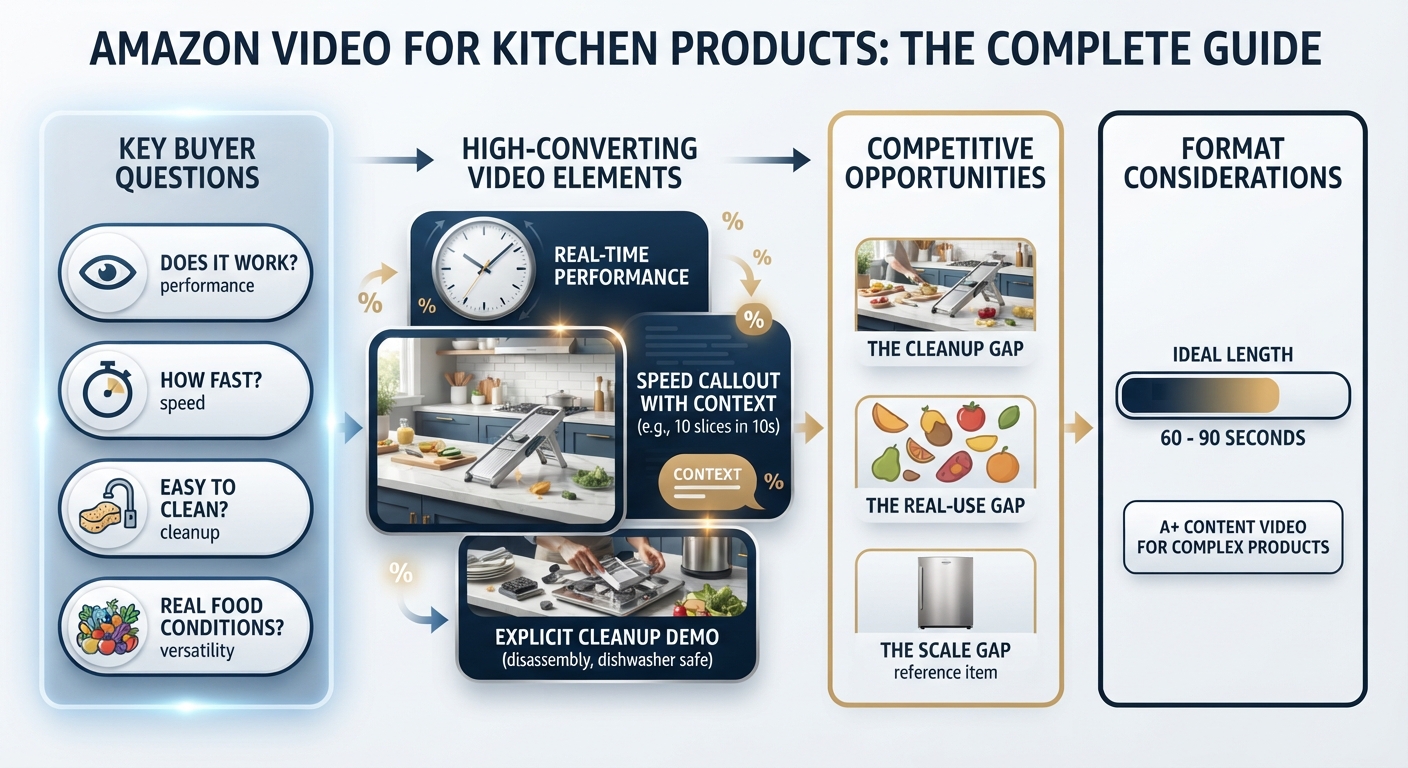
Does this actually work as well as it looks? Kitchen category buyers have an elevated level of skepticism about product performance claims, because the category has an unusually high density of products that look impressive in photography and disappoint in use. Video that demonstrates real-world performance — not optimal conditions, not staged perfect results — builds the credibility that photography claims cannot.
How fast is it? Speed is a primary purchase motivation for most kitchen tools. Buyers are looking for time savings, and "how quickly does this actually work" is one of the most common implicit questions in kitchen video. Video that specifically demonstrates speed with realistic timing — actual elapsed time, not edited to appear faster — converts better than demonstrations that omit timing context.
How hard is it to clean? Cleanup ease is the single most common objection in kitchen product negative reviews across virtually every kitchen subcategory. Buyers who have been burned by products that are difficult to clean — despite appearing easy-to-clean in their listing imagery — have heightened skepticism about any new kitchen product's cleanup claims. Video that specifically demonstrates the cleanup process — how the product comes apart, what goes in the dishwasher, how long cleanup actually takes — directly addresses the concern driving the most kitchen returns.
Will it work on my actual food? Kitchen tools that look impressive with perfectly sized and textured food in listing videos frequently disappoint when used with the variety of real food buyers actually prepare. Video that demonstrates the product with realistic, varied food — not just optimal examples — sets accurate expectations and reduces the most common return driver in this category.
The Kitchen Video Elements That Consistently Drive Conversion
Real-time performance demonstration. The most converting kitchen videos show real-time product performance — not accelerated, not edited to appear faster than reality. A mandoline that slices 10 vegetables in 45 seconds real-time demonstrates value more convincingly than edited footage that implies the same task happens instantly. Buyers watching real-time demonstration can directly evaluate whether the speed claim is relevant to their actual cooking time investment.
Explicit cleanup demonstration. For any kitchen product with meaningful cleanup complexity, dedicating 10 to 15 seconds specifically to the cleanup process is one of the highest-return additions to kitchen video. Show the product disassembled, show what's dishwasher safe and what isn't, show the hand-wash process for non-dishwasher components. This specific content directly addresses the concern driving the most returns in the category.
Food variety and real conditions. Demonstrating the product with multiple food types, sizes, and textures — including some that are slightly imperfect — sets more accurate expectations than demonstration with optimized examples. A spiralizer tested on perfectly uniform zucchini and then on a slightly crooked sweet potato communicates a more honest performance picture than one tested only on the ideal example.
Speed callout with context. Text overlays that provide timing context — "10 eggs in 45 seconds" rather than just showing the eggs being processed — convert better because they make the speed benefit explicit and immediately evaluable. Buyers can directly compare against their current approach.
Competitive Patterns and Opportunities in Amazon Kitchen Video
The kitchen category has several consistent competitive patterns that create specific creative opportunities for brands willing to differentiate.
The cleanup gap. Despite cleanup being the most common return driver in the category, most kitchen product listing videos don't include a cleanup demonstration. This creates a consistent opportunity: brands that specifically demonstrate easy cleanup in video convert higher among buyers who have been burned by difficult-to-clean products before — a large and growing segment of kitchen category buyers.
The real-use conditions gap. Most kitchen product videos demonstrate with optimal food examples under optimal conditions. Brands that demonstrate under realistic conditions — showing the product handling a range of real food preparation scenarios — build more credibility with skeptical buyers and reduce the expectation gap that drives returns.
The size and scale gap. Kitchen products frequently return due to size expectations that the listing didn't set correctly. Demonstrating scale with consistent reference points — showing the product next to a standard kitchen item, measuring the capacity explicitly in frame — reduces this specific return driver.
Kitchen Video Length and Format Considerations
The kitchen category has specific length dynamics that differ from other categories. Because the primary buyer questions (performance, speed, cleanup) all require demonstration time to answer convincingly, kitchen videos that are too short — under 45 seconds — frequently fail to address the full purchase decision adequately.
For most kitchen products, 60 to 90 seconds is the appropriate main listing video length — allowing time for context-setting, core performance demonstration, and cleanup demonstration without exceeding typical buyer engagement thresholds. For complex multi-function kitchen products where multiple use cases need demonstration, A+ Content video allows additional demonstration time for buyers who specifically seek it.
Ready to Build Kitchen Video That Converts?
At MyBrand Videos, kitchen category video is a core specialization — including work with the s'mores and outdoor entertaining brand that grew from one SKU to a full outdoor cooking catalog with our creative across every product.
Related articles:
