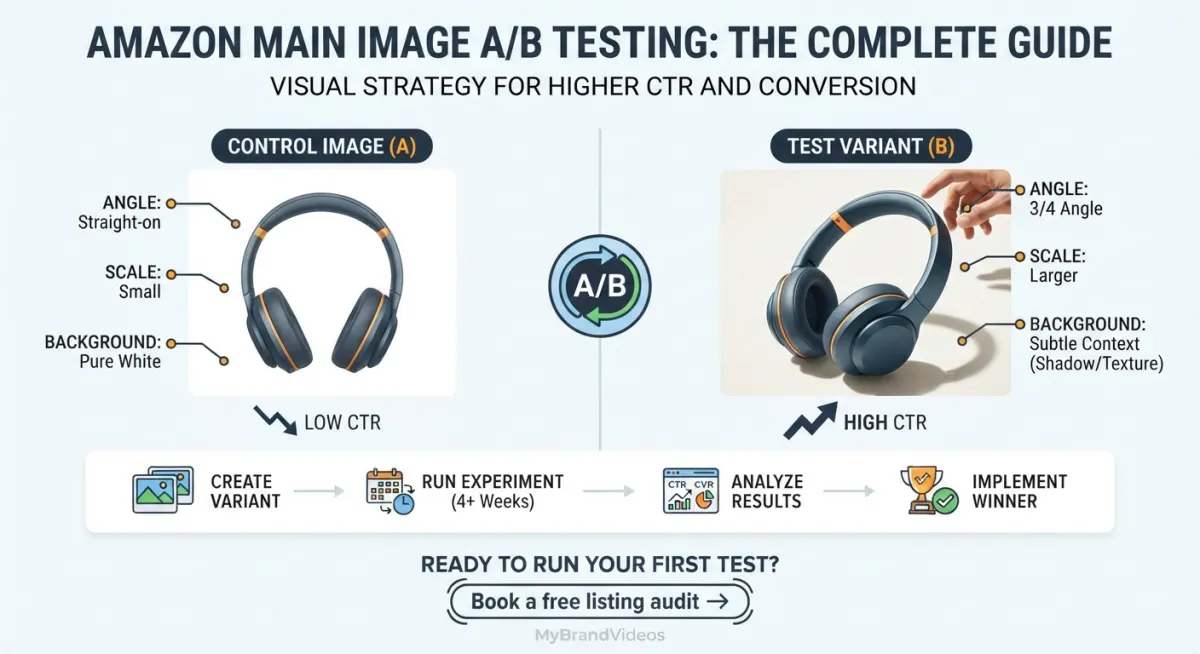
Amazon Main Image A/B Testing: The Complete Guide
Amazon main image testing — specifically, running structured A/B tests on your primary listing image — is consistently one of the highest-leverage optimization moves available to Amazon sellers, yet it remains far less common than the impact it delivers would suggest. The main image is the first visual element buyers encounter in search results, and its performance determines not just initial CTR but the quality of the traffic that reaches the listing.
This guide covers how Amazon main image testing works, what variables to test, how to run a structured experiment, and how to interpret results accurately.
Why Amazon Main Image Testing Has Outsized Impact
The main image does a job no other listing element does: it generates the click that brings a buyer to your listing at all. Without the click, the video, A+ Content, and optimized copy never get seen. Consequently, a main image that underperforms on CTR reduces the effectiveness of every other listing investment simultaneously.
This is why Amazon main image testing produces returns that compound differently from other optimizations. A better main image doesn't just improve CTR — it improves the volume of buyers who reach the listing and encounter every other conversion element. Furthermore, higher CTR itself signals to Amazon's algorithm that your listing is more relevant to the search query, which can positively influence organic rank on that keyword over time.
What Main Image CTR Actually Reflects
CTR on a main image reflects one specific buyer judgment made in a fraction of a second: does this result look like it matches what I'm looking for? It's a relevance judgment, not a quality judgment. An image that looks more expensive isn't always the higher-performing one — an image that looks more precisely like what the buyer searched for is.
Variables Worth Testing in Amazon Main Image Testing
Not every aspect of the main image is worth isolated testing. The variables with the most consistently significant impact on CTR and subsequent conversion are the following.
Product angle and orientation. The angle from which the product is photographed — straight-on versus three-quarter versus top-down — produces measurably different CTR in most categories. Furthermore, the specific orientation that wins often reveals important information about which product attribute the buyer is prioritizing in their initial scan.
Background treatment. Pure white versus off-white versus subtle lifestyle context is a variable that Amazon technically requires white backgrounds for main images, but the specific shade and any permitted contextual elements (shadows, reflection, surface texture) affect how products read in the search grid.
Scale and cropping. How much of the frame the product occupies, and how it's cropped relative to the image edges, significantly affects how the image reads in search results against competing thumbnails. A product that fills the frame aggressively often stands out against images with more white space — but the optimal cropping depends entirely on the competitive visual environment of your category.
Text overlays (where permitted). For categories where Amazon permits limited text overlays on main images, testing whether a key benefit callout improves CTR against a clean image reveals whether buyers in your category respond to information density or visual clarity at the thumbnail level.
Lifestyle versus pure product. In some categories, a main image that shows the product in use — a hand holding it, a person wearing it, the product in a relevant environment — outperforms a pure studio product shot by a margin that makes the test result unambiguous. In others, the clean studio shot wins. Amazon main image testing determines which is true for your specific category and buyer.
How to Run Amazon Main Image Testing Correctly
Amazon's Manage Your Experiments tool supports main image A/B testing for Brand Registry sellers, making it the most accessible starting point for most sellers.
Setting up the test. Create two versions of your main image — identical in all respects except the single variable being tested. Upload both through Brand Registry and configure the experiment in Manage Your Experiments with a test period of at least 4 weeks, preferably 6 to 8 weeks for listings with lower traffic volume.
Traffic allocation. Amazon automatically splits traffic between the two variants during the experiment period. Don't attempt to manually control which buyers see which image, as this introduces selection bias that makes results uninterpretable.
Letting the test run. The most important discipline in Amazon main image testing is resisting the temptation to end the test early. Initial data in the first 1 to 2 weeks frequently points in the direction that turns out to be wrong when the test reaches statistical significance. Specifically, the first-week sample is too small to be reliable and too compelling to ignore — which is why early termination of tests is one of the most common sources of bad creative decisions in this area.
Reading Amazon Main Image Testing Results
When a test completes at statistical significance, several specific interpretations are valuable beyond the simple win/loss outcome.
Primary metric — click-through rate. CTR is the primary metric for main image testing because the main image's primary job is to generate the click. A variant that improves CTR but not CVR is still valuable — it brings more buyers to the listing, where every other conversion element gets a larger audience to work with.
Secondary metric — conversion rate. Some main image variants improve CTR but reduce CVR because they attract buyers whose expectations don't match the product. A highly lifestyle-forward main image might drive more clicks from buyers who are drawn to the aspirational context but less likely to convert on this specific product. Tracking both CTR and CVR provides a complete picture of whether the main image is improving the quality as well as the volume of traffic.
Combined metric — revenue per impression. The most comprehensive metric combines CTR and CVR into revenue per impression — what each search result display is worth in dollar terms. This metric accounts for both the click generation and the post-click conversion, providing a single number that reflects total main image contribution to revenue.
Ready to Run Your First Amazon Main Image Test?
At MyBrand Videos, main image optimization is part of our full listing creative packages — and we build testing variants into the photography production brief so clients have images ready for structured comparison rather than testing one image against whatever existed before.
Related articles:
