Amazon Video A/B Testing: Strategy Guide for Sellers
Amazon video A/B testing is the practice that separates sellers who know what works from sellers who assume they do. Most brands produce a video, publish it, and measure its performance against a baseline that's impossible to interpret cleanly — because too many variables changed at once. Structured testing changes that entirely.
This guide covers the practical mechanics of Amazon video A/B testing: which variables to test, in what order, with what tools, and how to read the results without drawing conclusions that the data doesn't actually support.
Why Amazon Video A/B Testing Produces Different Results Than Intuition
Creative decisions made without testing tend to reflect the preferences of whoever has authority in the room — the founder, the marketing manager, the agency creative director. These preferences often diverge substantially from what actual buyers respond to, for a simple reason: buyers don't share the brand's internal perspective on its own product.
Amazon video A/B testing removes that internal bias by substituting real buyer behavior for internal opinion. A hook that feels bold and attention-grabbing internally might generate less engagement than a quieter, problem-focused alternative. A testimonial format that feels unnecessarily raw to a production-minded team might outconvert polished alternatives by a significant margin. The testing determines the answer — internal preference doesn't.
Furthermore, this matters more as revenue scales. The cost of making a suboptimal creative decision on a listing with limited traffic is relatively small. Consequently, the same decision at $200,000 in monthly revenue represents a meaningful opportunity cost that accumulates every month the wrong creative remains in place.
The Specific Difference Between Creative Testing and Guessing
The distinction is not just philosophical. An untested creative update might improve CVR, have no effect, or actually reduce it — and without a controlled comparison, you can't know which happened. Structured Amazon video A/B testing generates a clear, attributable answer: version A performed at X, version B performed at Y, and the difference is statistically meaningful. That clarity is worth more than any individual creative insight.
The Core Variables Worth Testing in Amazon Video A/B Testing
Not every element of a video warrants a dedicated test. The variables with consistently high impact on conversion and, therefore, highest testing priority are the following.
The opening hook. The first three to five seconds of a listing video determine whether the buyer continues watching. Testing a problem-led hook against a benefit-led hook, or a product-forward open against a lifestyle-forward open, frequently produces meaningful conversion differences — often more than testing later sections of the same video.
The thumbnail. For listing videos, the still frame shown before play begins is effectively the "main image" of the video. Buyers who never press play convert at zero from the video — which means thumbnail performance directly affects how much of the video's persuasive content reaches buyers at all. Testing different thumbnails against the same video content often reveals substantial differences in play rate that translate directly to conversion.
Buyer persona framing. A video that leads with a specific buyer's situation — a French Bulldog owner, a home chef, a runner training for their first marathon — outperforms generic lifestyle footage for buyers who see themselves in that specific framing. Testing persona-specific variants against a generic version tells you how much specificity matters for your category and audience.
Social proof placement. Testing testimonial content in the first third of a video against the second half consistently reveals placement effects that most sellers wouldn't intuitively predict. In most categories, testimonials perform better after the product has been introduced — but your specific category and buyer may behave differently, which is exactly why testing determines this rather than assumption.
Video length variants. Testing a shorter version against a longer version of the same core content addresses a question most sellers answer with a rule of thumb rather than evidence — and frequently produces counterintuitive results.
Tools for Running Amazon Video A/B Testing
The tooling available for video testing on Amazon is more limited than for other listing elements, but a combination of native and supplemental tools makes systematic testing practical.
Amazon Manage Your Experiments. This native tool allows Brand Registry sellers to run controlled experiments on A+ Content modules, including video placement within A+ Content. While direct video-to-video comparison isn't fully supported as a head-to-head test within this tool, it's the most reliable way to test placement decisions and module arrangement that include video components.
Amazon Attribution. For sellers driving external traffic, Amazon Attribution allows tracking of video-specific performance across different traffic sources — providing engagement data that isn't available through Seller Central alone.
Third-party analytics tools. Several tools provide video engagement metrics including play rate, watch time segments, and completion rate at the ASIN level. These metrics don't replace conversion data but supplement it with engagement signals that help diagnose why a video is or isn't performing.
What Counts as a Valid Test Period
A common mistake in Amazon video A/B testing is concluding tests too early. A listing with 200 sessions per week needs approximately 4 to 6 weeks at minimum to generate statistically meaningful conversion data from a test variant. High-traffic listings can reach significance faster, but the temptation to call results early — especially when initial data favors one variant — frequently produces false conclusions that get baked into creative decisions.
Building an Amazon Video A/B Testing Calendar
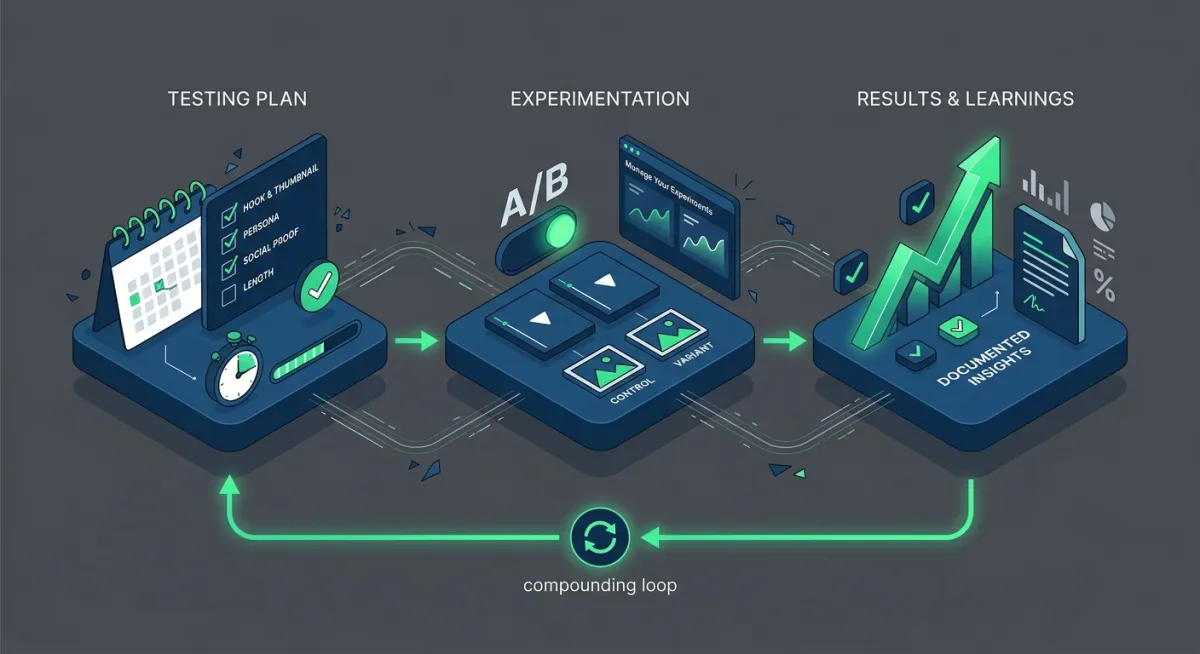
Effective testing requires a calendar that prioritizes variables in sequence rather than testing multiple elements simultaneously.
Quarter One: Hook and Thumbnail Priority
The first quarter of a testing program should focus on hook and thumbnail — the two elements with the highest impact on whether buyers engage with the video content at all. Improving play rate before optimizing the content itself ensures the improved content reaches more buyers, compounding the benefit of later tests.
Quarter Two: Persona and Structure Testing
Once hook and thumbnail have reached a defensible winning state, the focus shifts to buyer persona variants and video structure — specifically whether problem-led or benefit-led narrative structures outperform for the specific audience.
Quarter Three: Social Proof and CTA Testing
Later testing rounds address social proof format, placement, and the video close — elements that are important but whose impact is only cleanly measurable once the earlier, higher-leverage elements have been optimized.
This sequenced approach prevents a common failure mode where sellers test lower-impact variables first, reach inconclusive results because the foundation isn't strong, and conclude that testing doesn't work for their listing.
Reading Amazon Video A/B Testing Results Accurately
Test results require careful interpretation to produce useful conclusions rather than misleading ones.
Statistical significance matters. A conversion difference between two variants that hasn't reached 90 to 95 percent statistical confidence is not a reliable signal — it may reflect normal traffic variation rather than a genuine performance difference. Both Amazon's native tools and most third-party analytics platforms surface significance calculations directly. Consequently, the practice of reading tests before significance is reached almost always produces false conclusions.
Look for patterns across segments, not just averages. A variant that outperforms overall might underperform for specific traffic sources or time periods. If organic traffic and paid traffic respond differently to the same creative variant, that's useful intelligence for how to adapt the creative rather than a reason to dismiss the test.
Document what you learn, not just what you implement. Each test generates insights beyond the binary win/loss outcome — about which buyer the winning variant appeals to, what objection it addresses more effectively, and what creative direction to explore in the next cycle. That institutional knowledge is as valuable as the conversion improvement itself.
Ready to Build a Structured Amazon Video A/B Testing Program?
At MyBrand Videos, Amazon video A/B testing is integrated into every production engagement — not an afterthought. Each piece of creative we produce comes with a defined testing plan: which variable it tests, how it differs from the control, and what metric determines the winner.
If your current listing has video but no testing infrastructure behind it, you're operating on assumptions that may or may not match what your buyers actually respond to.
We'll review your current creative and show you specifically what a structured testing program would look like for your top ASINs.
Related articles:
