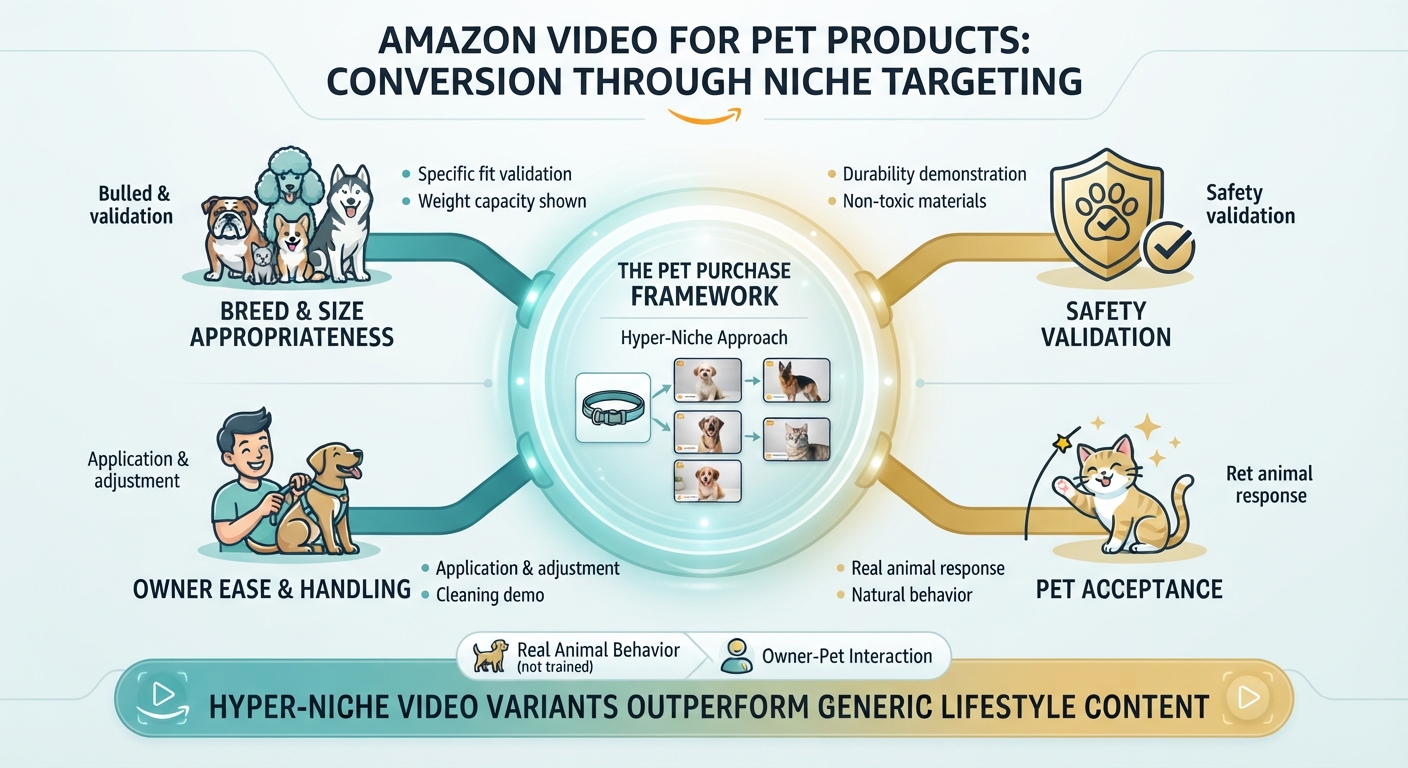
Amazon Pet Product Video: What Actually Drives Conversion
Amazon pet product video has a specific conversion dynamic that doesn't apply equally to other categories: the buyer is not the end user. A dog owner buying a collar, a cat owner buying a treat dispenser, or a bird owner buying enrichment toys is purchasing for a third party whose specific characteristics — breed, size, age, temperament — are central to the purchase decision in a way that most other product categories don't replicate.
This fundamental structure of the pet purchase decision has specific implications for how Amazon pet product video should be briefed, produced, and tested.
Why Generic Lifestyle Video Underperforms in the Pet Category
The generic pet product video approach — a happy dog in a backyard, an owner smiling while playing with their pet — is the visual equivalent of "we are passionate about pets." It communicates the right sentiment without communicating anything specific enough to resolve the purchase decision for a buyer with a particular animal.
A buyer searching "large breed training collar" has a specific dog in mind. Their conversion decision depends on whether this collar is appropriate for the breed, size, and temperament of their specific dog — not whether dogs in general seem happy using it. Lifestyle content that features a generic medium-sized dog in a generic outdoor setting doesn't answer that question. Content that specifically features a large breed dog and explicitly addresses sizing, fit, and appropriateness for powerful breeds does.
This is why hyper-niche targeting — producing multiple variants of pet product video that each specifically feature and address a particular breed size, breed type, or owner profile — consistently outperforms generic pet lifestyle video in the pet category on Amazon.
The Pet Purchase Decision Framework
Understanding the pet purchase decision framework clarifies what video content needs to address for different pet product subcategories.
Breed and size appropriateness. For any pet product where suitability varies by animal characteristics — collars, harnesses, beds, gates, toys — the primary buyer question is "is this right for my specific animal?" Video that directly addresses size range, weight capacity, or breed-specific suitability answers this question more effectively than any written specification.
Safety validation. Pet owners are highly motivated by safety — the product must not harm the animal it's designed for. For food products, treats, toys with small parts, and any product the animal will interact with directly, video that demonstrates the product's safety characteristics — durability under stress testing, non-toxic materials, appropriate size range for age — addresses the safety concern that underlies much pet purchase hesitation.
Owner ease and handling. Unlike most product categories where the buyer uses the product themselves, pet products require a handling relationship between buyer and pet. Video that demonstrates how easy the product is to apply, adjust, put on a moving animal, or clean after use addresses the practical ease-of-use concern that affects whether a product stays in use after purchase.
Pet acceptance. Buyers genuinely worry about whether their specific animal will accept a new product — particularly for collars, harnesses, beds, and enrichment items where animal preference matters. Video that shows a real animal (rather than a trained model animal) responding naturally to the product addresses this concern more effectively than any written description.
Hyper-Niche Targeting in Amazon Pet Product Video
The hyper-niche approach that MyBrandVideos pioneered for pet product video treats each buyer segment — defined by breed, size, or owner profile — as a distinct audience requiring distinct creative.
For a training collar that fits breeds from 30 to 100 pounds, the hyper-niche approach produces separate video variants for: small-to-medium breeds (showing a Golden Retriever or Labrador), large breeds (showing a German Shepherd or Rottweiler), and extra-large or powerful breeds (showing a Great Dane or Mastiff). Each variant features the same product but demonstrates fit, appropriate use, and suitability specifically for that size range.
The conversion improvement from this approach is significant because it removes the buyer's need to extrapolate — to imagine whether the product that looks good on the Golden Retriever in the listing video will work for their 90-pound German Shepherd. When the German Shepherd owner sees their breed specifically in the video, the purchase decision becomes much simpler.
AI-Hybrid Production for Pet Product Video Variants
Producing multiple breed-specific variants through traditional production requires multiple shoot days, multiple animal models, and multiple times the budget. AI-hybrid production changes this equation significantly — starting with high-quality raw footage of the product with real animals and using AI to generate additional breed-specific lifestyle variants that expand coverage without multiplying shoot costs.
This approach was central to our work with a Florida pet brand that needed coverage across multiple dog breeds and owner profiles — producing the variety of variant content that traditional production would have cost several times as much to achieve.
Category-Specific Video Elements That Convert in Pet Products
Beyond hyper-niche targeting, several video elements consistently outperform others in the pet category specifically.
Real animal behavior, not trained animal performance. Trained animals behave in ways that look slightly unnatural on camera — too controlled, too obedient, too cooperative. Buyers recognize this subconsciously and it reduces the authenticity signal that drives pet purchase confidence. Real animals with normal behavior — some distraction, normal energy levels, realistic responses to the product — convert better because they match what buyers expect to experience with their own animals.
Owner-pet interaction over product-only demonstration. Pet products where the owner-animal relationship is part of the use experience — training equipment, toys, enrichment products — convert better when video shows the interaction rather than just the product's function in isolation.
Size references that are category-specific. In the pet category, size reference matters differently than in other categories. Showing a product's dimensions next to a tape measure is less effective than showing it on an animal of a specific, identifiable size — because pet buyers think in breed and weight rather than inches.
Ready to Build Pet Product Video That Converts Across Buyer Segments?
At MyBrand Videos, pet category video is one of our most developed specializations. We've produced hyper-niche pet video across dog breeds, cat types, and owner profiles — using AI-hybrid production to generate buyer-segment coverage efficiently.
Related articles:
