Amazon Supplement Video: Strategy That Converts in 2026
Amazon supplement video operates in one of the most trust-constrained categories on the platform. Buyers who purchase supplements are making decisions about what goes into their bodies — which makes the trust dimension of the purchase decision more significant than in almost any other product category. The video that converts in this context isn't primarily the one that demonstrates efficacy most convincingly. It's the one that builds the specific type of credibility that allows a buyer to trust the brand behind the product.
This guide covers Amazon supplement video strategy — the trust signals that matter most in this category, the formats and structures that consistently convert, and the compliance considerations that affect what supplement brands can and cannot claim in video content.
The Trust Architecture of Supplement Video
Unlike most product categories where conversion is primarily driven by demonstrating function and addressing buyer objections about practical product characteristics, supplement conversion is driven primarily by trust in the brand's quality, transparency, and credibility.
This is because supplements — by their nature — cannot be tested or observed during the purchase decision in the way that most physical products can. A buyer purchasing a kitchen tool can see whether it looks well-made and imagine how it will function. A buyer purchasing a supplement cannot see efficacy, cannot verify ingredient quality from the bottle, and cannot assess manufacturing standards from the listing images. Everything they're trying to evaluate before purchase must be communicated through the listing — and video is the most powerful tool available for communicating the non-visual trust signals that drive this category.
The Three Trust Dimensions Supplement Video Must Address
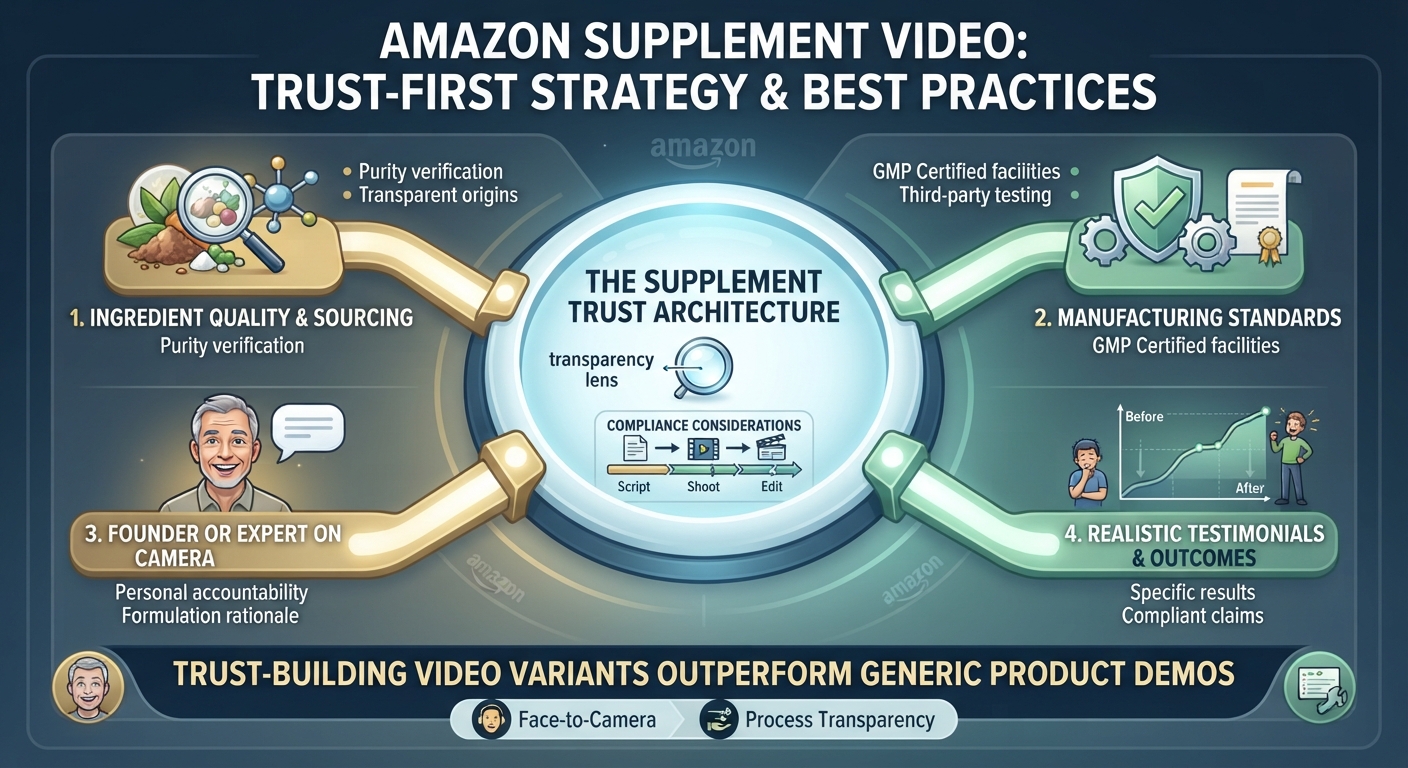
Ingredient quality and sourcing. Buyers in the supplement category increasingly understand that ingredient source and quality vary significantly across brands, and that price alone doesn't predict quality. Video content that specifically shows or explains sourcing — specific ingredient origins, quality testing at intake, visible transparency about what's in the product — builds the ingredient trust dimension that written claims alone struggle to establish.
Manufacturing standards. Third-party certifications, GMP compliance, and manufacturing facility standards are the supplement buyer's primary signal that the product was made safely and consistently. Video that references these standards specifically — not just mentions them in text overlays but visually demonstrates their meaning — builds manufacturing credibility more effectively than a bullet point list.
Formulation rationale. Buyers who are research-oriented (common in the supplement category, particularly for premium products) want to understand why the formulation is the way it is — why these specific ingredients at these doses, why this delivery format, why these additional components. Video that explains formulation rationale in accessible language connects with this buyer segment and builds the expertise credibility that justifies premium pricing.
Video Formats That Convert in the Supplement Category
Several specific video formats consistently outperform generic lifestyle or product demonstration video in the supplement category.
Founder or formulator on camera. Video featuring the founder, head of formulation, or a qualified expert speaking directly about the product's development, ingredient choices, and quality standards builds personal credibility that no other format can match. The face-to-camera format communicates accountability — a real person is standing behind this product — in a way that produced brand content cannot replicate.
Transparency and process video. Video that shows the manufacturing or testing process — even briefly, even at a level of abstraction that doesn't reveal proprietary process details — communicates openness that builds trust. Buyers interpret transparency content as evidence that the brand has nothing to hide.
Customer testimonial focused on specific outcomes. In the supplement category, testimonials that describe specific, realistic outcomes over a realistic timeframe outperform testimonials that make dramatic claims. A testimonial that says "after 8 weeks I noticed I was sleeping more consistently" is more credible — and therefore more converting — than a testimonial that says "I've never felt better." Specificity and realism are more persuasive than enthusiasm.
Before-and-after with compliance. Amazon has specific requirements for before-and-after content and health claims in the supplement category. Compliant before-and-after content — showing realistic, representative results with appropriate disclosure language — can be a strong conversion driver in this category when executed within compliance requirements.
Compliance Considerations for Amazon Supplement Video
The supplement category has specific Amazon content policies and FTC guidelines that affect what can be claimed in listing video content.
Disease claims are prohibited. Video content cannot claim that a supplement treats, cures, prevents, or mitigates any disease. This applies to video narration, text overlays, and on-screen testimonials. Structure claims around general wellness outcomes rather than disease-specific ones.
Testimonials require disclosure and representative results. Video testimonials should reflect typical results for typical users — not outlier results presented as typical. Where testimonials reference specific outcomes, FTC guidance requires disclosure language indicating whether results are typical.
Third-party certifications must be current and accurate. Video content that references specific certifications — NSF, USP, Informed Sport, and others — must reference only current certifications held by the actual product being advertised. Expired certifications or certifications held by other products in the line but not the specific ASIN advertised constitute misrepresentation.
Supplement Video and the Omnibiotics Case
Our work with Omnibiotics — a supplement brand that approached us needing video across their full product line — illustrates how trust-building video strategy works in practice. We produced a nine-video series that covered different products across their catalog, with each video structured around the specific trust dimension most relevant to that product's buyer.
For their probiotic line, the primary trust dimension was formulation transparency — buyers wanted to understand strain selection and CFU counts in accessible language. For their sleep support product, the primary trust dimension was the founder's personal experience with the formulation. For their immune support line, the primary dimension was manufacturing standards and testing protocols.
Each video addressed the trust dimension relevant to its product's specific buyer segment — rather than applying a generic supplement brand template across the full line.
Ready to Build Trust-First Supplement Video?
At My Brand Videos, supplement category video is one of our most developed specializations — across probiotic, immune support, sleep, cognitive, and sports nutrition subcategories.
Related articles:
