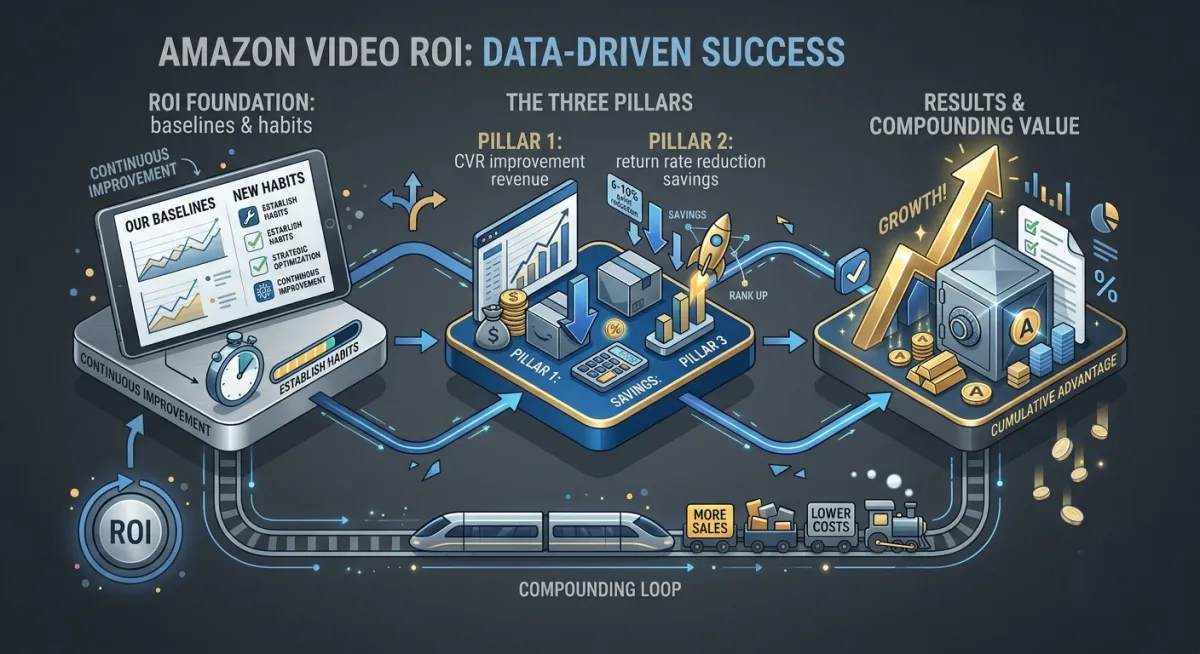
Amazon Video ROI: The Data-Driven Framework for Sellers
Amazon video ROI is more predictable than most sellers assume — because the mechanism driving returns is measurable, the inputs are known, and the math is straightforward. The challenge isn't calculating it; it's that most sellers haven't built the habit of calculating it, which means they're making video investment decisions based on intuition rather than data.
This guide provides a practical framework for measuring Amazon video ROI across conversion improvement, return rate reduction, and organic rank gains — with specific calculations by revenue level so the numbers apply to your situation directly.
Why Amazon Video ROI Is Underestimated by Most Sellers
The most common reason sellers undervalue video ROI is that they evaluate it as a cost rather than an investment. A $2,500 video production appears as a line item expense — and like most marketing expenses, its return isn't immediately obvious without deliberate measurement.
Furthermore, the return from video compounds over time in ways that make simple month-one calculation understate the actual value. A video that improves conversion rate continues generating additional revenue every month it remains live. A video that improves organic rank generates compounding traffic gains. A video that reduces return rates saves money on every order indefinitely.
Consequently, the relevant calculation for Amazon video ROI isn't "did this video pay for itself this month?" but rather "what is the cumulative return from this video over its usable lifetime?"
Setting Up the Measurement Foundation
Before calculating returns, establish clean baselines. Specifically, document your current conversion rate, return rate, and organic rank position for your priority keywords during a representative 30-day period before any video update. Without a documented baseline, post-video performance data is impossible to attribute accurately — any improvement might reflect seasonal traffic, competitor changes, or pricing adjustments rather than the video itself.
The Three Pillars of Amazon Video ROI Calculation
Video generates measurable return across three distinct mechanisms, each of which can be calculated independently and then combined for a comprehensive Amazon video ROI figure.
Pillar one: conversion rate improvement revenue. Take your monthly sessions multiplied by your average selling price. A conversion rate improvement of, say, 18 percent on a listing with 3,000 monthly sessions and a $45 ASP generates: 3,000 sessions × 0.18 CVR improvement × $45 = $24,300 in additional annual revenue from that single improvement. That calculation makes the return on a $2,500 video investment obvious within the first month.
Pillar two: return rate reduction savings. Calculate your current monthly return volume by multiplying sessions by conversion rate by return rate. Then apply the expected return rate reduction — typically 4 to 8 percentage points for products where expectation mismatch drives returns. For a product moving 500 units per month at a $45 ASP with a 14 percent return rate, reducing that rate to 9 percent saves approximately $1,125 per month — $13,500 annually — in product cost, reverse logistics, and lost revenue.
Pillar three: organic rank improvement value. This is the most complex pillar to calculate precisely, but also potentially the most significant over time. As video improves conversion rate, organic rank strengthens. As organic rank improves, organic traffic increases. Additional organic traffic generated without additional ad spend represents direct cost savings. Specifically, estimate the CPM equivalent of your organic impressions to quantify what that traffic would have cost through paid placements.
Amazon Video ROI by Revenue Level
The return profile from video investment looks meaningfully different at different revenue levels, which is why a one-size-fits-all assessment doesn't serve most sellers well.
$500K–$1M Annual Revenue
At this level, most listings have moderate traffic but are often in the early stages of competitive positioning. Video investment typically generates its clearest returns through conversion improvement — particularly for listings adding professional video for the first time. A conservative 15 percent CVR improvement at $80K monthly revenue generates $12,000 in additional monthly revenue. Against a $2,500 to $4,000 video investment, this pays back within days.
$1M–$3M Annual Revenue
At this revenue level, listings typically have stronger traffic but increasingly sophisticated competition. Video ROI at this stage comes not just from first-time implementation but from testing and iteration — replacing underperforming video with tested variants that consistently outperform the original. Additionally, the return rate reduction pillar becomes proportionally more significant as order volume increases.
$3M+ Annual Revenue
At the highest revenue tier, the compounding effects of video strategy are most pronounced. Multiple ASINs benefit simultaneously from a systematic approach. Organic rank improvements generate substantial traffic gains that accumulate over many months. Testing infrastructure creates compounding improvements in conversion across the full catalog. At this level, the most meaningful frame for Amazon video ROI is not individual video performance but the annual return from a structured creative system against its annual cost.
What Reduces Amazon Video ROI — And How to Avoid It
Several specific patterns consistently undermine the return from video investment, and understanding them is as important as the calculation itself.
Producing video without a strategic brief. Video produced without understanding which specific buyer objections to address generates lower conversion improvement than video built around documented conversion gaps. Consequently, the ROI calculation starts lower than it should before the video even launches.
Failing to test. A video that hasn't been tested against an alternative might be the third or fifth best version of that concept — meaning significant additional return is sitting untested. Testing systematically captures return that untested video leaves behind.
Failing to update. A video produced two years ago is competing against video produced last month by competitors who've refined their approach based on testing and shifting buyer expectations. Video that isn't periodically refreshed depreciates in competitive effectiveness even without any changes to the listing itself.
Measuring too early. Organic rank improvement — the most significant long-term return driver — typically takes 60 to 90 days to manifest meaningfully. Sellers who evaluate ROI at 30 days and find it disappointing are often measuring before the primary return mechanism has fully activated.
Building a Simple Amazon Video ROI Dashboard
Tracking the three pillars doesn't require sophisticated tooling — a basic spreadsheet updated monthly provides sufficient insight for most sellers.
Track unit session percentage weekly in Seller Central. Track return rate monthly from your returns report. Track keyword rank position for your top 5 to 10 terms using your preferred rank tracking tool. Calculate the monthly revenue difference from baseline for each metric, and sum them for a total monthly return figure. Against the monthly cost equivalent of your video investment (amortized over its expected useful life), this produces a clean ongoing ROI figure that tells you precisely what your video system is generating.
Ready to Build a Data-Driven Amazon Video Investment?
At MyBrand Videos, Amazon video ROI isn't an afterthought — it's built into how we scope and approach every production. We start with your current metrics and calculate the expected return range before production begins, so investment decisions are grounded in data rather than optimism.
We'll build the ROI calculation for your specific revenue level and show you exactly what video investment is realistically worth for your current listing performance.
Related articles:
