Amazon Video Script: How to Write One That Converts
An Amazon video script is the most important document in any listing video production — and the one most often treated as an afterthought. Most sellers think of scripting as writing narration for a video that's primarily visual. The best Amazon video scripts are actually conversion documents: a structured sequence of buyer-specific arguments, each designed to move the buyer one step closer to purchase, expressed in language the buyer would use rather than the language the brand uses internally.
This guide covers how to write an Amazon video script that converts — the structure that works, the language principles that matter, and the specific mistakes that produce scripts that tell the product's story instead of answering the buyer's questions.
Why Most Amazon Video Scripts Underperform
The most common reason an Amazon video script fails to drive conversion isn't the production quality that follows it — it's the orientation of the script itself. Scripts written from the brand's perspective cover what the brand wants buyers to know: features, specifications, brand story, competitive claims. Scripts written from the buyer's perspective cover what the buyer needs to hear in order to feel confident purchasing.
These are different documents. Furthermore, the difference in conversion performance between them is substantial and measurable.
A buyer arriving at an Amazon listing doesn't need to be educated about the product category. They already know they want something in this category — that's why they're there. What they need is specific answers to the specific questions their browsing and consideration have produced: will this work for my situation, does it hold up, is the price worth it, has someone like me had a good experience with it?
The script that answers those questions in that order converts. The script that explains the product's features in order of the brand's priorities doesn't.
The Buyer-First Amazon Video Script Structure
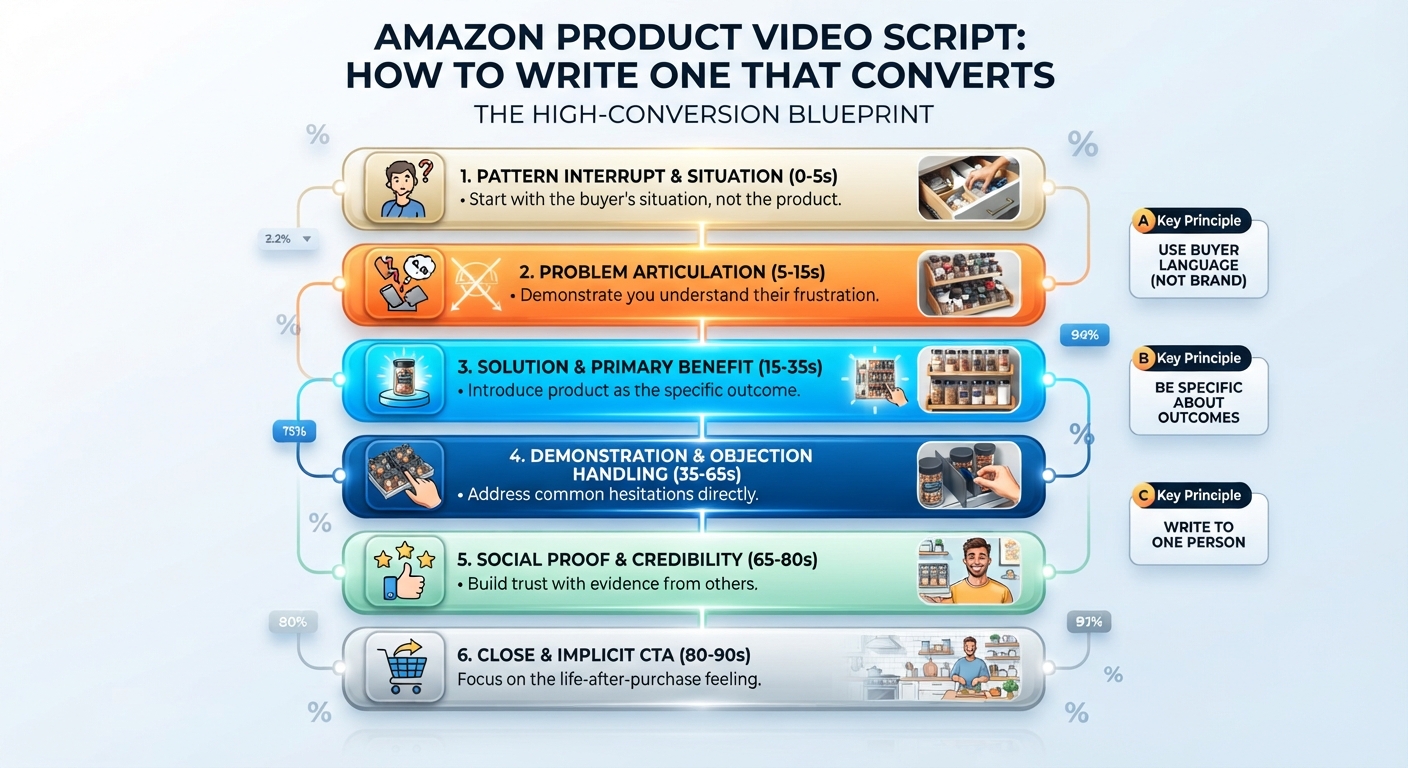
High-converting Amazon video scripts follow a buyer-first structure that maps to the buyer's decision-making sequence rather than the brand's communication priorities.
Section one: Pattern interrupt and situation identification (0–5 seconds). The opening frames of an Amazon video script determine whether buyers continue watching. The most effective openings don't begin with the product — they begin with the buyer's situation. "If you've ever tried to organize a small kitchen and run out of space..." or "For runners who need a shoe that holds up past mile 8..." — these openings create immediate identification for the target buyer and establish that what follows is specifically for them.
Section two: Problem articulation (5–15 seconds). After identifying the situation, the script briefly articulates the specific frustration or limitation that the buyer has been experiencing. This section is critical because it demonstrates that the brand understands the buyer's problem — which is a prerequisite for the buyer trusting that the brand's solution will actually work. Keep this section tight; it's setup for the solution, not the main argument.
Section three: Solution introduction and primary benefit (15–35 seconds). This is where the product is introduced — not with a feature list, but with a clear statement of the primary benefit it delivers. The best solution introductions are specific about the outcome: "this is what changes" rather than "this is what it does." Furthermore, the primary benefit should match the frustration articulated in section two — making the connection between problem and solution explicit.
Section four: Demonstration and objection handling (35–65 seconds). The middle section of the script accompanies the core product demonstration. Narration or text overlays in this section should address the most common buyer objections in order of their likelihood to prevent purchase. "You might be wondering if this works for..." or showing specific use conditions that buyers worry about — durability, ease of use, compatibility, size — directly resolves the hesitations that would otherwise prevent conversion.
Section five: Social proof and credibility (65–80 seconds). For videos including testimonial or social proof elements, this section places them after the product has been introduced and demonstrated — the moment when a buyer is most receptive to evidence from others. The credibility element should come from a source that matches the target buyer's profile.
Section six: Close and implicit CTA (80–90 seconds). The close of an Amazon video script should leave the buyer with a clear emotional picture of the outcome of purchase — what their life looks like with this product in it — rather than an explicit sales message. Amazon video CTAs are typically implied rather than stated directly, because the purchase mechanism (the Add to Cart button) is immediately visible on the listing page without narration.
Language Principles for Amazon Video Scripts
Beyond structure, the language choices in an Amazon video script significantly affect conversion performance.
Use buyer language, not brand language. Buyers call things by the names they search for, not the names the brand uses internally. If buyers search "easy grip jar opener," the script should use "easy grip jar opener" — not "ergonomic rotary lid removal device." The vocabulary alignment signals to buyers that the brand understands their world.
Be specific about outcomes. "You'll love it" is a claim. "Your breakfast prep time drops from 20 minutes to 8" is evidence. Specific, quantified outcomes convert better than subjective enthusiasm — because they give the buyer something concrete to evaluate against their own situation.
Keep sentences short. Video narration is absorbed in real time — unlike text, which buyers can re-read. Sentences longer than 12 to 15 words frequently lose buyers before the thought completes. Additionally, short sentences are easier to display as text overlays without crowding the frame.
Write to one person, not an audience. "If you're a busy parent looking for..." converts better than "For busy parents who need..." because it addresses the buyer as an individual rather than as a demographic. This is a small language shift with a measurable impact on how personally relevant the content feels.
Common Amazon Video Script Mistakes
Opening with the brand or product name. Buyers who don't recognize the brand don't care about the brand name in the first five seconds. Starting with brand identification before establishing relevance wastes the highest-engagement moment in the video.
Listing features without connecting to benefits. "Six adjustable settings, stainless steel construction, dishwasher safe" are features. "Adjusts to your exact preference, built to last for years, cleans in seconds" are benefits. The connection between feature and benefit is obvious to the brand but not always to the buyer — the script should make it explicit.
Covering too much. A 90-second Amazon video script that tries to address every product feature, every buyer segment, and every possible use case produces a video that addresses no buyer completely. Pick the most important objection, the most relevant buyer, and the most compelling benefit — and do those three things well.
Ready to Build Scripts That Actually Convert?
At My Brand Videos, scripting is where we invest the most pre-production time. Before a single shot is planned, we research your review themes, competitive messaging, and buyer language — then build a script that addresses the specific conversion gap we've identified.
Related articles:
