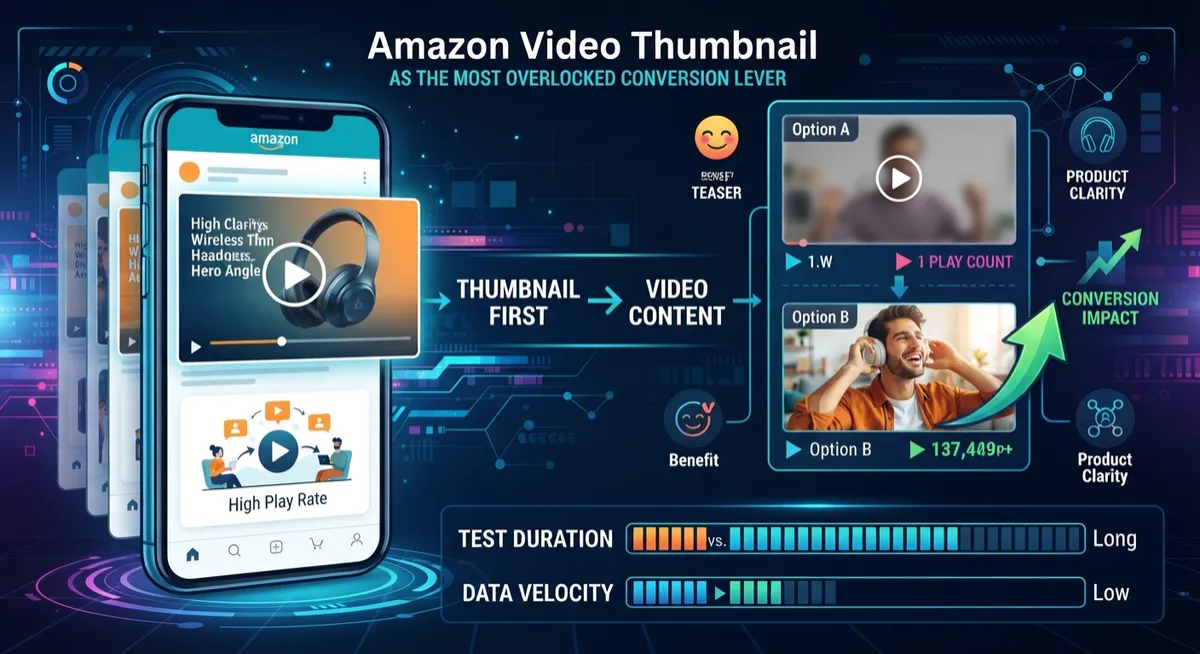
Amazon Video Thumbnail: The Most Overlooked Conversion Lever
Amazon video thumbnail optimization is the single most overlooked conversion lever in listing video strategy. Most sellers invest significant time and budget into producing compelling video content and then give almost no thought to the still frame that determines whether any buyer ever plays that video. The thumbnail is the video's first impression — and buyers who never press play convert at zero from the video, regardless of how persuasive the content is.
This guide covers what makes an Amazon video thumbnail drive high play rates, how to test thumbnails systematically, and why thumbnail optimization often produces faster and larger conversion impact than optimizing the video content itself.
Why the Amazon Video Thumbnail Is a Separate Optimization From Video Content
A common assumption in listing video strategy is that thumbnail and video content are evaluated together — that buyers who see the thumbnail and play the video experience them as a continuous asset. In practice, they're two separate decisions with two separate audiences.
Decision one: does the thumbnail make me want to press play? This decision is made in under a second, based entirely on what the static thumbnail communicates about whether the video is worth watching.
Decision two: does the video content persuade me to purchase? This decision is made by only the buyers who made the first decision affirmatively.
The implication: improving play rate by 20 percent has the same effect as improving video conversion rate by 20 percent — both move total video-attributed purchases by the same amount, assuming conversion quality doesn't change. However, thumbnail optimization is often faster and less expensive than rebuilding video content — which makes it the higher-leverage starting point for most listing video optimization programs.
What High-Performing Amazon Video Thumbnails Communicate
The Amazon video thumbnail needs to accomplish one specific job in under one second: communicate that this video contains something relevant and worth watching for the buyer currently looking at this listing.
This job can be accomplished through several different thumbnail approaches, and the best-performing approach varies significantly by category and buyer type.
Product clarity and hero angle. The most common effective thumbnail shows the product from its most impressive or distinctive angle with clear, uncluttered composition. This approach works best for products where visual design or aesthetic quality is a primary purchase driver — the thumbnail communicates quality in a way that prompts buyers to want to see more.
Lifestyle context preview. A thumbnail showing the product in use, in a relevant lifestyle setting, works well for products where use-context is central to the purchase decision. This approach signals "this video will show you what using this product actually looks like" — which is specifically what buyers most often want to see.
Benefit or result teaser. A thumbnail that shows the result of using the product — the organized space, the completed dish, the clean countertop — creates curiosity-driven play behavior in categories where outcome is the primary purchase motivation. Buyers play the video to understand how the result was achieved.
Face and emotion. For products where personal testimony and emotional connection are primary trust drivers — baby products, wellness items, personal care — a thumbnail featuring a person with a clearly positive emotional expression signals "this video contains real experience with this product" in a way that product-only thumbnails don't.
Common Amazon Video Thumbnail Mistakes
Using the first frame of the video. Video editing software often defaults to the first frame as the thumbnail — which is frequently a fade-in from black, a title card, or an unrepresentative moment. Almost any deliberately selected frame will outperform the default first frame as a thumbnail.
Text-heavy thumbnails. Text overlays on thumbnails typically underperform purely visual thumbnails because the text competes with the visual for attention in the fraction of a second the buyer gives to the evaluation. If text is included, it should be minimal — a single benefit callout at most.
Poor contrast with listing images. The video thumbnail appears in the same visual stack as the gallery images. A thumbnail that is visually similar to the surrounding gallery images doesn't stand out as a distinct content type. Thumbnails that are visually distinct from the gallery — through different framing, different lighting, or explicitly showing product use — perform better because they signal a qualitatively different type of content.
Not testing. Most sellers never test their video thumbnail against alternatives. Given that thumbnail plays such a significant role in determining how many buyers even engage with the video content, this represents one of the clearest untested opportunities in most listing optimization programs.
Testing Amazon Video Thumbnails
Thumbnail testing is among the most accessible tests available in Amazon listing optimization because it requires no new video production — only selecting a different still frame or uploading an alternative static image as the thumbnail.
What to test. The highest-impact thumbnail tests compare fundamentally different approaches rather than minor variations: product-focused vs. lifestyle-context, person vs. product, result-showing vs. product-showing. These category-level differences in approach produce meaningful play rate differences, while minor variations in cropping or color rarely reach statistical significance.
How to measure. Play rate is the primary metric for thumbnail testing — the percentage of listing visitors who press play on the video. Where analytics tools provide this metric directly, it's the clearest signal of thumbnail performance. Where play rate isn't directly available, CVR change correlated with thumbnail change provides a directionally useful indication.
Timeline. Thumbnail tests typically reach meaningful signal faster than content tests because play rate is a simpler, higher-frequency behavior than conversion — more buyers make the play decision than the purchase decision, which means statistically meaningful data accumulates faster.
Amazon Video Thumbnail Optimization in the Testing Sequence
Within the overall Amazon video A/B testing priority sequence, thumbnail optimization should come before content optimization. The logic is straightforward: optimizing video content that most buyers never play is optimizing below the funnel.
The correct sequence is to establish a strong thumbnail that maximizes play rate first, then optimize the content that the maximum possible number of buyers will see. Testing in the reverse order — optimizing content before establishing strong play rate — means that content test results reflect the behavior of only the subset of buyers who happened to play the video under the current (potentially underperforming) thumbnail.
Ready to Optimize Your Amazon Video Thumbnail?
At MyBrand Videos, thumbnail selection is a deliberate production decision — we capture multiple candidate frames during production specifically to enable thumbnail testing, rather than defaulting to whatever frame the editing software selects.
Related articles:
