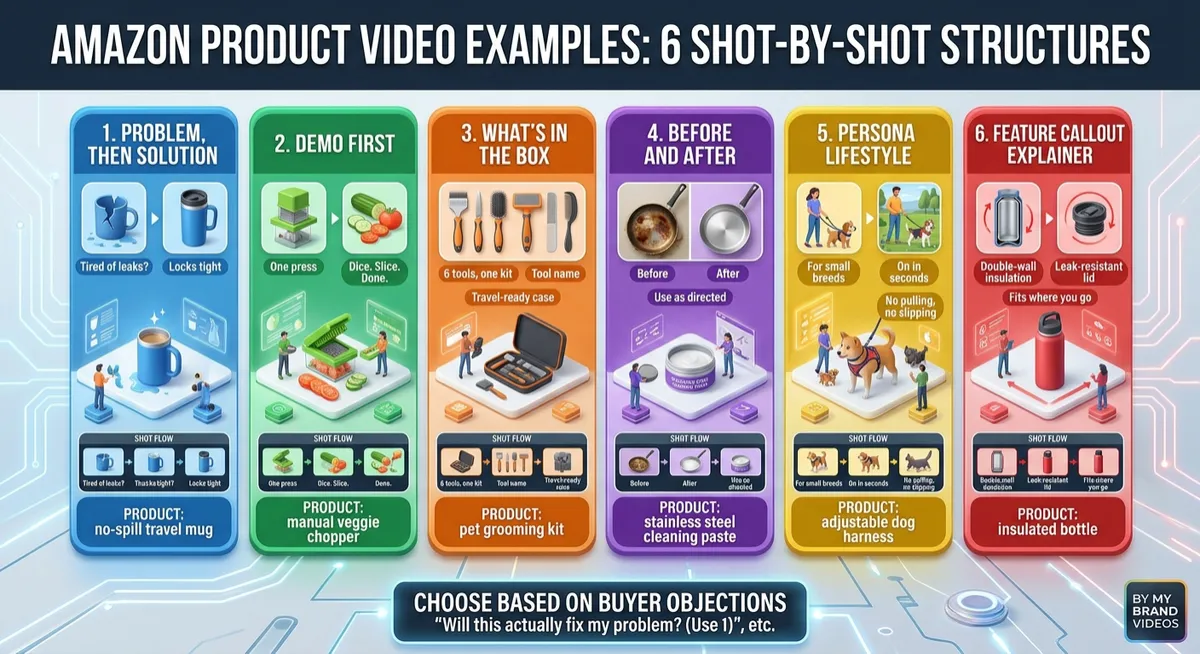
Amazon Product Video Examples: 6 Shot-by-Shot Structures
The best Amazon product video examples share a structure, not a style. Whether the product is a dog harness, a kitchen gadget, or a supplement, strong videos tend to follow one of a handful of shot-by-shot patterns. Each pattern answers a different buyer question in a different order.
Instead of showing you a gallery to admire, this guide turns the best Amazon product video examples into six reusable structures with timing, the shot in each slot, and the on-screen text. The products named below are illustrative, not client work, so you can adapt each structure to your own listing.
How to Read These Amazon Product Video Examples
Each structure below has a timeline table. Times are approximate, and you can compress or stretch them to fit your product. Every structure also lists the buyer question it answers, because the right structure depends on what stops shoppers from buying.
First, check your reviews before choosing one and Q&A for the main objection. Then match the objection to the structure. If you also need a script, our guide to writing an Amazon video script covers the words that go with these shots.
Structure 1: Problem, Then Solution
Buyer question it answers: "Will this actually fix my problem?"
This is the most dependable structure for products that solve an irritation. It opens on the frustration, so the right shopper recognizes themselves immediately.
Illustrative product: a no-spill travel mug.
Time | Shot | On-screen text |
|---|---|---|
0–3 s | Coffee tipping over in a bag | "Tired of leaks?" |
3–8 s | Close-up of the sealed lid locking | "Locks tight" |
8–15 s | Mug thrown into a bag, shot from above | "Toss it in anything" |
15–22 s | Hot drink poured, lid closed, steam visible | "Stays hot" |
22–28 s | Product on a desk with the brand name | Brand name |
Why it works: The first frame earns attention by naming a feeling. Without it, the video starts as a generic product tour.
Structure 2: Demo First
Buyer question it answers: "How does it work?"
Some products need no setup. The demo is the hook. Skip the story and show the product doing the thing within the first second.
Illustrative product: a manual vegetable chopper.
Time | Shot | On-screen text |
|---|---|---|
0–2 s | Onion chopped in one press | "One press" |
2–9 s | Three vegetables, three results, side by side | "Dice. Slice. Done." |
9–16 s | Blade removal and rinse | "Easy to clean" |
16–22 s | Everything fits back in the container | "Stores flat" |
Why it works: For an inexpensive, simple product, proof of function is enough. Extra storytelling only delays the answer.
Structure 3: What's in the Box
Buyer question it answers: "What exactly do I get?"
Bundles and kits benefit from a clear inventory. This structure also reduces the "not as expected" returns that come from confusion about contents. For more on that outcome, see our article on how video can reduce Amazon returns.
Illustrative product: a six-piece pet grooming kit.
Time | Shot | On-screen text |
|---|---|---|
0–3 s | Box opens, tools laid out in a flat lay | "6 tools, one kit" |
3–18 s | Each tool shown for two to three seconds, used on a dog | Tool name |
18–24 s | Carrying case closes | "Travel-ready case" |
24–28 s | Full kit with the brand name | Brand name |
Why it works: Shoppers can count the items and see the use for each. Fewer surprises mean fewer disappointed buyers.
Structure 4: Before and After
Buyer question it answers: "Is the difference real?"
This works best when the change is visible: cleaning, organizing, lighting, or finish. Because it makes a comparison, keep claims accurate and avoid naming any competitor.
Illustrative product: a stainless steel cleaning paste.
Time | Shot | On-screen text |
|---|---|---|
0–3 s | A stained pan, close-up | "Before" |
3–10 s | Applying the paste and wiping | "One wipe" |
10–16 s | The same pan, same angle, clean | "After" |
16–22 s | Product tub with usage tip | "Use as directed" |
Why it works: The identical camera angle is what makes it believable. Change the angle and viewers assume the result was staged.
Structure 5: Persona Lifestyle
Buyer question it answers: "Is this made for someone like me?"
Here, the same product is shown in the hands of a specific buyer. This is where creative testing gets interesting, because you can produce several versions for different audiences. Our article on Amazon UGC video strategy explains how to keep these versions authentic.
Illustrative product: an adjustable dog harness.
Time | Shot | On-screen text |
|---|---|---|
0–3 s | A small-breed dog at the door, owner reaching for the harness | "For small breeds" |
3–10 s | Harness going on in two clips | "On in seconds" |
10–18 s | Walk outdoors, harness visible in motion | "No pulling, no slipping" |
18–24 s | Close-up of adjustment straps | "Adjusts to fit" |
Why it works: Specificity creates identification. A version made for large breeds can reuse the structure with a different dog and different on-screen words.
Structure 6: Feature Callout Explainer
Buyer question it answers: "Why does this cost more than the others?"
Premium products need to justify price. This structure uses short, labeled feature moments in a fixed rhythm. It overlaps with explainer video, which we cover in our guide to Amazon explainer video for listings.
Illustrative product: an insulated stainless steel bottle.
Time | Shot | On-screen text |
|---|---|---|
0–3 s | Bottle rotating, clean studio shot | Product name |
3–9 s | Cutaway of double-wall construction | "Double-wall insulation" |
9–15 s | Lid detail and gasket close-up | "Leak-resistant lid" |
15–21 s | Bottle in a car cup holder and on a trail | "Fits where you go" |
21–26 s | Hero shot with brand | Brand name |
Why it works: Each feature gets one clear shot and one short label. Viewers can scan them without audio.
How to Choose From These Amazon Product Video Examples
Match the structure to the objection you see most often in reviews and questions.
"Does it leak, break, or fail?" → Problem, then solution or Demo first
"What comes with it?" → What's in the box
"Does it really work?" → Before and after
"Is it right for my situation?" → Persona lifestyle
"Is it worth the price?" → Feature callout explainer
Many brands combine two of these Amazon product video examples. For example, open with a problem hook, then move into a feature callout sequence. Keep the total length tight, and remember that every shot should earn its place.
Before You Copy These Amazon Product Video Examples
A great structure still fails if the file is rejected. Review Amazon product video requirements for the technical specs and content rules before you plan the shoot, especially the restrictions on prices, links, and competitor logos. Then use the structure that fits, and also capture extra angles so you can test variations later.
Our listing video optimization guide covers how to evaluate the finished cut.
Want These Structures Built for Your Product?
At My Brand Videos, we turn these Amazon product video examples into custom structures built around your buyer's main objection, then produce listing and PPC versions you can test against each other. Book a free listing audit and we will tell you which structure suits your product.
Related articles:
